
Furnace Maintenance in Layton, Utah
Layton's water comes from the Delta Aquifer through Layton City wells, mixed with Weber Basin Water Conservancy District wholesale supply. Hardness runs 6.5 to 9.9 grains per gallon, softer than the canonical 13+ GPG Salt Lake County average.
That changes how aggressively we inspect for scaling on condensing-furnace secondary heat exchangers compared to the canonical pattern.
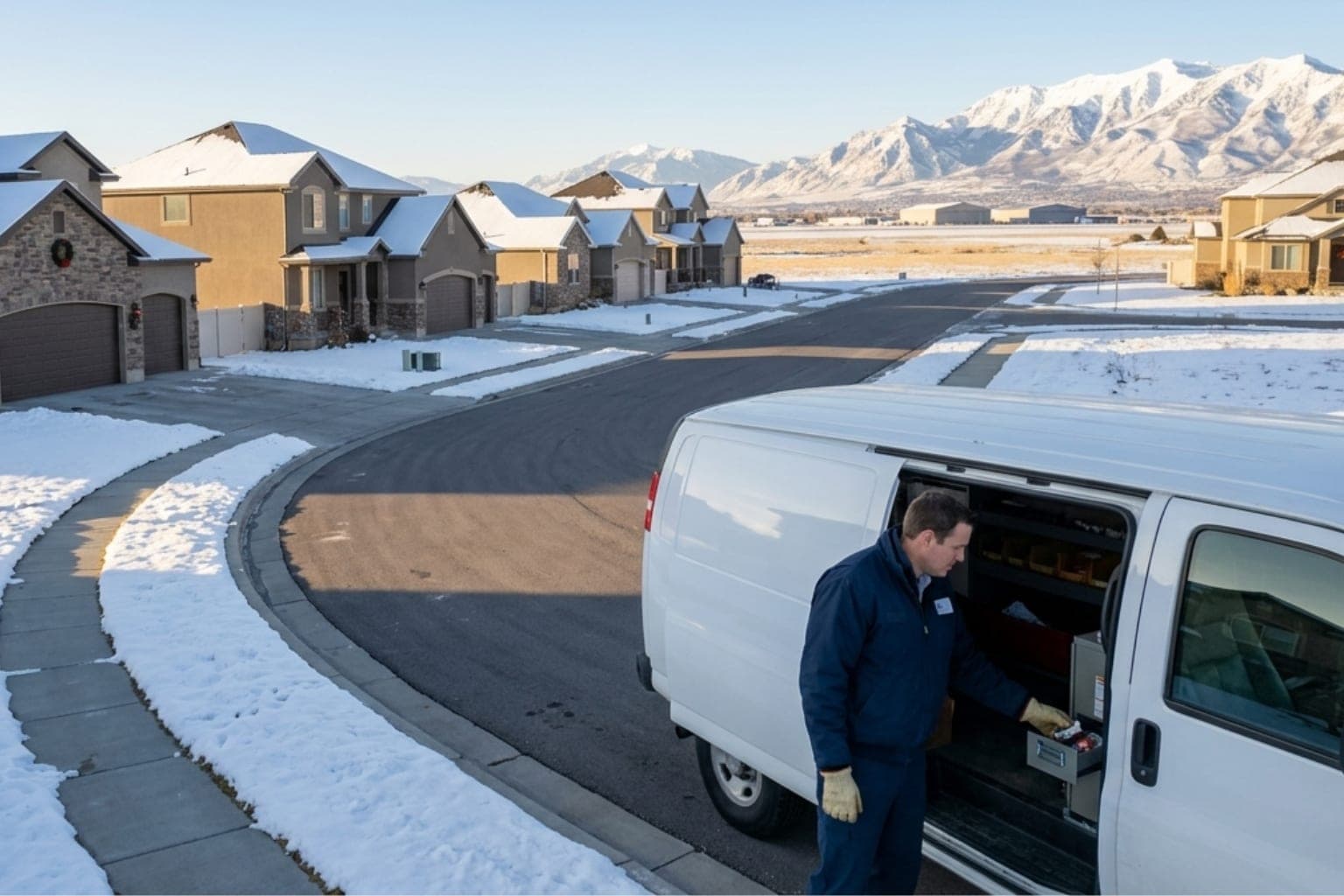
Why Maintenance Matters in Layton
What we check during a tune-up depends on whether you're on the valley floor or up near the bench. 1990s-era 80% AFUE units in Heritage Park and Layton Hills need second-cycle scope. East-bench Layton near Adams Canyon needs cold-pool exposure and elevation-driven combustion-air verification.
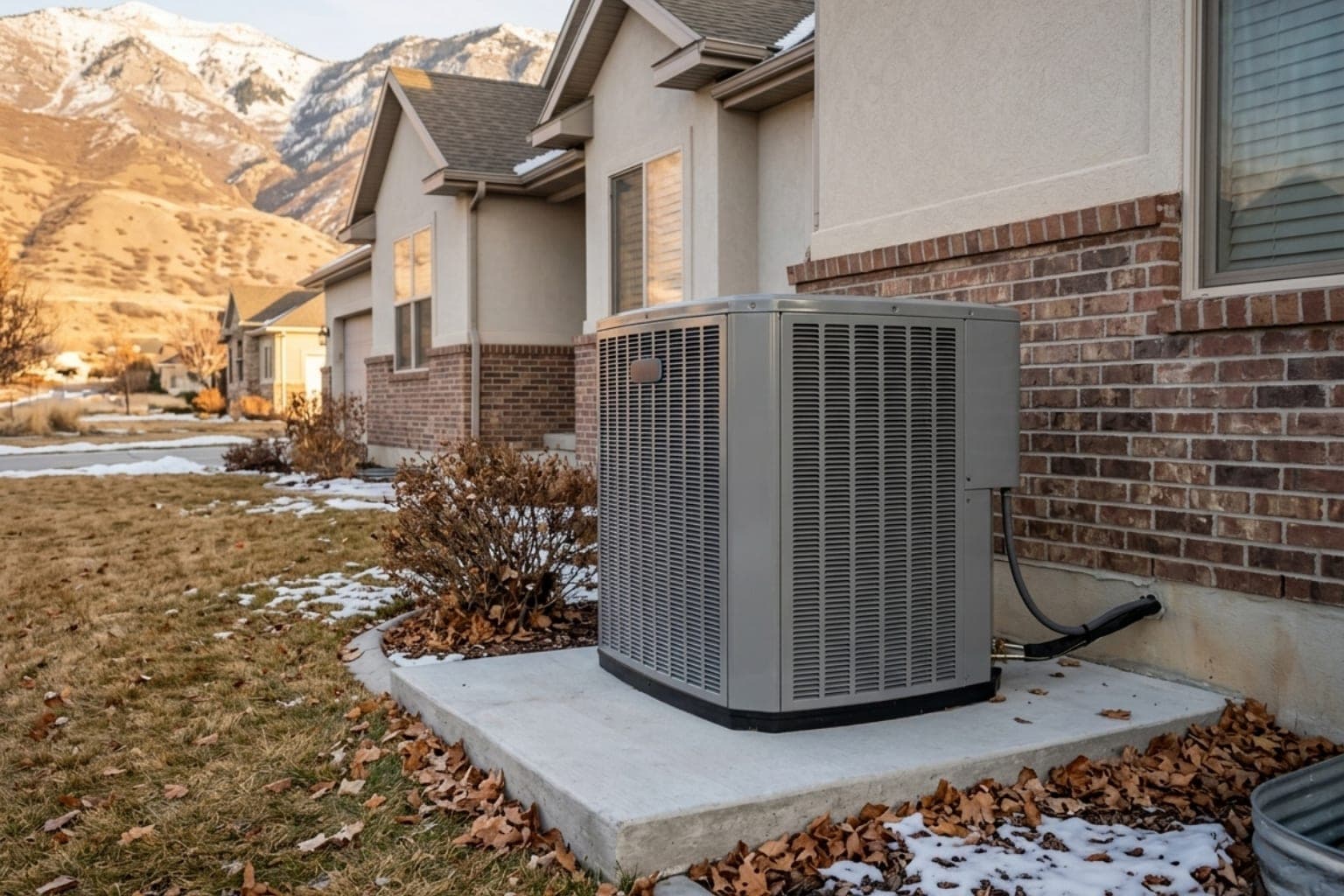
What a 21-Point Tune-Up Includes
Safety checks: CO testing, gas leak detection, heat exchanger inspection, venting verification
Combustion analysis: Gas pressure verification, altitude calibration, flame inspection
Mechanical inspection: Blower motor, bearings, belt, inducer motor, thermostat calibration
Cleaning: Burner assembly, flame sensor, air filter, blower wheel, condensate drain
Electrical testing: Safety controls, limit switches, capacitor, wiring connections
Housing Stock and Heating Patterns in Layton
Tune-up scope depends on which Layton housing era your home is from.
In 1980s-1990s tract housing (most of the city), the equipment is usually a second-cycle replacement of the original 80% AFUE upflow. Median construction year citywide is 1993. Most replacements landed at 80% AFUE in the early 2000s and are now 20+ years old. We focus on heat exchanger inspection (visual borescope check year over year for cracks) and CO testing. We also check capacitor wear, blower motor condition, gas valve manifold pressure verification, and the original galvanized B-vent flue at the chimney chase.
In post-2000 infill across western and northern Layton, the equipment is mostly first-generation 90%+ AFUE condensing units, some now reaching first replacement. We add condensate trap inspection, sidewall vent termination check (especially after heavy winter snow), and inducer motor diagnostic.
In east-bench Layton above 4,800 feet near Adams Canyon and the eastern terminus of SR-193, the equipment is similar to valley-floor stock. It just cycles more often due to cold-air drainage off the canyon. We add elevation-driven combustion-air verification and check for short-cycle wear patterns even on relatively new equipment.
Either way, we replace the filter and size the next change interval based on inversion-season particulate loading. Valley-floor Layton at 4,210 to 4,400 feet follows the canonical 30-to-45-day cadence at MERV 11. East-bench Layton above 4,800 feet sits closer to the inversion ceiling, with cadence stretching to 45 to 60 days during inversion season.
Maintenance Patterns for Layton Homes
Three recurring maintenance items in Layton have specific local notes worth knowing.
First, water hardness. Layton City Water Department serves the city using local groundwater from the Church Street, Hillfield, Fort Lane, Greenleaf, and Shop wells in the Delta Aquifer. WBWCD wholesale water is mixed in seasonally. WBWCD's headquarters sits inside Layton at 2837 East Highway 193. Secondary-water coordination with the district runs faster here than in cities further from the WBWCD service core.
Hardness runs 6.5 to 9.9 grains per gallon (about 112 to 169 mg/L), which is the moderately-hard range. That's softer than the canonical 13+ GPG Salt Lake County average. Layton's secondary heat exchanger scaling rate on condensing furnaces runs lower than the canonical pattern implies. The profile is similar to South Jordan's 7-to-10 GPG and Murray's 11.7 GPG range.
Second, secondary water timing. Layton has three providers in its secondary-water system. WBWCD's secondary system (Layton City crews handle leak and pressure response since spring 2017 under an operational support agreement). Layton City (formerly the Kays Creek Irrigation service area). And Davis & Weber Counties Canal Company. Service calls during shoulder seasons (fall and spring) sometimes overlap with secondary-water-system shutdowns and restarts. We coordinate around those windows when scheduling tune-ups in late October and early April.
Third, air quality. Layton sits in the Salt Lake Valley Serious Area PM2.5 nonattainment zone (Davis County is included). The standard inversion-season filter cadence applies on the valley floor. East-bench homes above the inversion ceiling stretch the cadence as noted above.
If you're replacing a natural-gas water heater alongside the furnace, HB 313 (2025) added NOx limits effective July 1, 2025. The limits still apply because we're in PM2.5 nonattainment.
Related Service Depth for Layton
A few things on this page show up in broader form on our service pages.
Our furnace maintenance page covers the canonical Salt Lake County hard-water content (13+ grains per gallon average) and the inversion-season filter loading framework. Layton's 6.5-to-9.9 GPG range is a softer-direction override on that canonical content, in the same direction as South Jordan and Murray.
Our gas furnace repair page covers altitude calibration depth. Layton's 600-to-800-foot east-bench differential at the Adams Canyon end of SR-193 fits the elevation framework used on the canonical page.
Local Context for Layton Homeowners
Two scheduling notes specific to Layton.
The standard fall-service window (September through October) applies. PCS-cycle move patterns in late spring and early summer drive a secondary scheduling spike. Military families inheriting unfamiliar furnaces often book a combined system assessment and tune-up before their first Utah winter. We batch those to fit within base-housing transition timelines.
East-bench Layton condensing-furnace homes also benefit from a quick spring vent-clearance check after heavy winter storms. Cold-air drainage from Adams Canyon and exposure on north-facing canyon-mouth lots are why.
If cost is a barrier, two programs can help. The federally-funded HEAT (Home Energy Assistance Target) program and the Utah Weatherization Assistance Program. Both run through Utah's Department of Workforce Services. Eligibility is income-based and open to non-citizens with qualifying status. Federal incentives also apply where eligible.
One note on Layton's history: the city was settled in the 1850s and incorporated in 1920. Layton has been Davis County's largest city since 1985, when it surpassed Bountiful. The Hill AFB economic anchor (the base went active in 1940) drove most of the build-out from the 1970s onward. That timing sets the city's housing-era profile and the second-cycle replacement pattern that drives our service work today.
Serving Layton Neighborhoods
Our partner technicians serve all Layton neighborhoods including East Layton, Layton Hills, Heritage Park.
Zip codes served: 84040, 84041
Need a Furnace Technician? We'll Match You in Minutes.
Call now or fill out our form to get connected with a licensed, background-checked heating technician in your area. Same-day availability in most locations.
DOPL-Licensed · Same-Day Dispatch · After-Hours Available
Why Homeowners Trust Us
We vet every technician in our network so you don't have to. Here's what sets our partner techs apart.
Licensed & Insured
Every technician in our network is state-licensed, fully insured, and background-checked for your peace of mind.
Same-Day Service
Most service calls are scheduled within 2-4 hours. Emergency dispatch available evenings, weekends, and holidays.
DOPL-Licensed Network
Every technician we connect you with carries an active Utah Division of Professional Licensing (DOPL) HVAC contractor license and full liability insurance. License status is verifiable through the Utah DOPL public lookup.
Transparent Estimates
You receive a written estimate before any work begins. The diagnostic charge is stated up front and rolls into your repair invoice once you approve the work, so there is no separate billing for the visit. No hidden charges, no surprise add-ons after the technician arrives.
What Utah Homeowners Say
Real reviews from homeowners we've connected with trusted local technicians.
“Our furnace died on the coldest night of the year. I called Utah Furnace Repair and they had a licensed tech at our door within 2 hours. He diagnosed the problem, had the part on his truck, and we had heat before bedtime. Incredible service.”
Sarah M.
Salt Lake City, UT
“I was quoted $4,000 by another company for a furnace replacement. Utah Furnace Repair connected me with a tech who found the real issue: a $200 igniter replacement. Honest, skilled, and saved me thousands.”
Mike T.
Sandy, UT
“From the phone call to the finished repair, the whole experience was seamless. The technician was on time, explained everything clearly, and left the work area spotless. I’ll be using this service for all my HVAC needs.”
Jennifer R.
West Valley City, UT
“We needed a new furnace installed in our home in SunCrest. The tech they matched us with was knowledgeable about high-altitude installations and did an outstanding job. Highly recommend.”
David L.
Draper, UT
“Scheduled a fall tune-up through Utah Furnace Repair. The technician was thorough, found a cracked heat exchanger we didn’t know about, and probably saved us from a dangerous situation. So grateful for the quality of their network.”
Lisa K.
Murray, UT
“Fast, professional, and affordable. The tech arrived exactly when they said he would, fixed our furnace in under an hour, and the price was very fair. This is how home services should work.”
Robert H.
Bountiful, UT
Frequently Asked Questions
Service Areas Across Utah
Our network of licensed technicians serves communities throughout the Salt Lake City metro and beyond.
Salt Lake City
Salt Lake County
200,000+ residents
Sandy
Salt Lake County
96,000+ residents
Draper
Salt Lake County
51,000+ residents
West Valley City
Salt Lake County
140,000+ residents
West Jordan
Salt Lake County
116,000+ residents
South Jordan
Salt Lake County
77,000+ residents
Murray
Salt Lake County
50,000+ residents
Midvale
Salt Lake County
35,000+ residents
Taylorsville
Salt Lake County
60,000+ residents
Bountiful
Davis County
44,000+ residents
Ogden
Weber County
87,000+ residents
Herriman
Salt Lake County
55,000+ residents
Riverton
Salt Lake County
45,000+ residents