Boiler Repair by Specialists Who Know Utah's Older Homes
Boilers require specialized knowledge. Our partner techs handle steam, hot water, and radiant systems.
Boiler Service Across the Wasatch Front
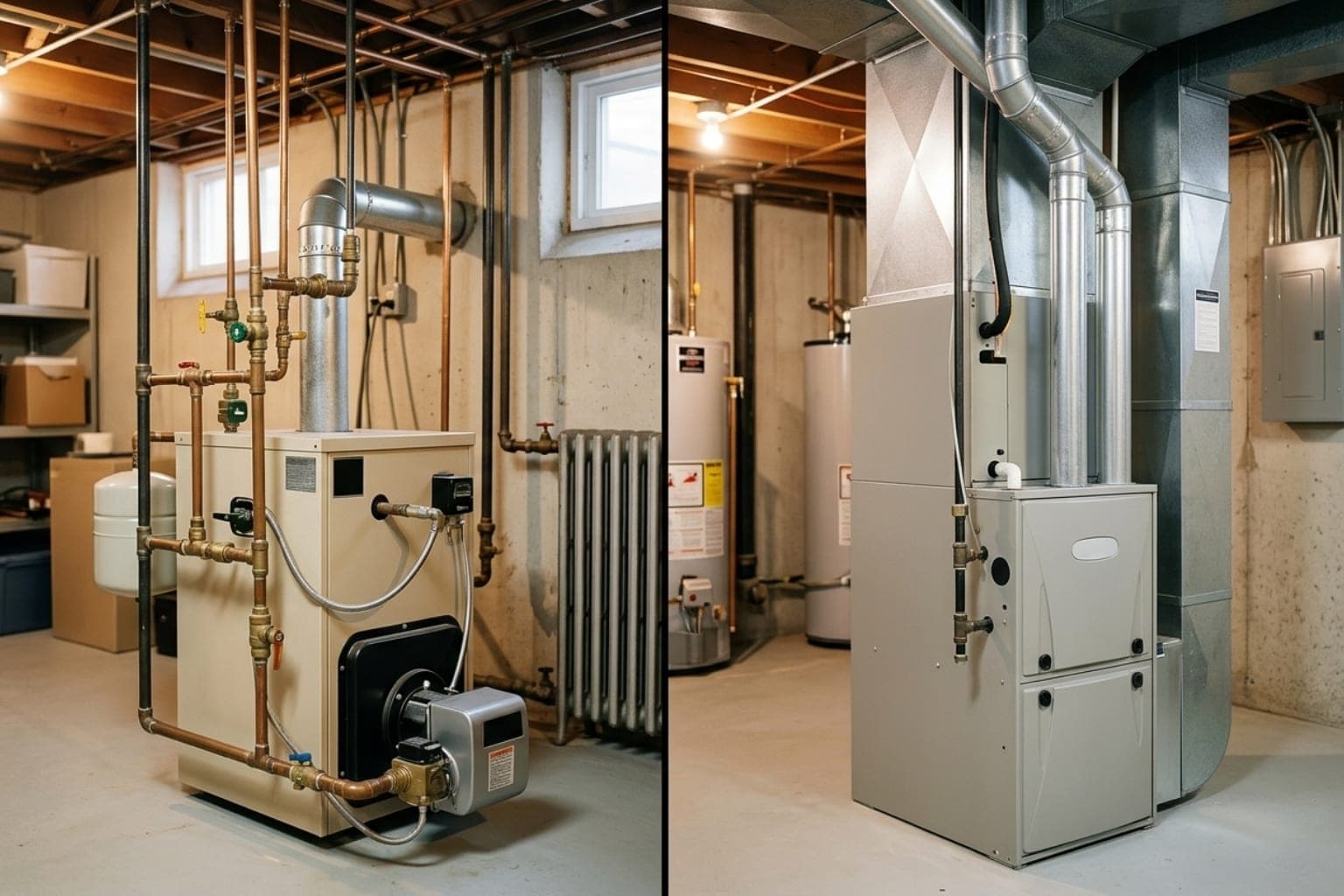
Boiler repair is a different animal than furnace repair. Furnaces heat air; boilers heat water and pump it through pipes to radiators or in-floor tubing. The parts that fail are different too: circulator pumps (the small electric pumps that push water through the system), expansion tanks (a small tank that absorbs pressure changes as water heats up), pressure relief valves, zone valves, and the heat exchanger (the metal chamber where the burner heats the water). We connect Utah homeowners with licensed technicians who actually work on boilers regularly, from old cast iron units in century-old Avenues homes to modern high-efficiency boilers in newer construction.
Common Boiler Problems
No Heat or Insufficient Heat
If your boiler isn't producing heat, the failure is usually in one of four places: the circulator pump (water isn't moving through the loop), the aquastat or thermostat (the burner isn't firing because the controls aren't calling for heat), the gas valve or pilot ignition (combustion isn't starting), or the expansion tank and pressure system (low pressure has tripped the safety lockout).
The technician checks system pressure first (12 to 15 PSI cold operating is normal), tests the aquastat for proper relay function, listens for circulator pump operation during a heat call, and inspects the burner sequence. Failed circulator pumps run $300 to $700 installed; aquastat replacement runs $150 to $400.
Boiler Leaking Water
Water leaking from a boiler points to one of five sources: a failed pressure relief valve (PRV) that's discharging from overpressure, a cracked section on a cast iron sectional boiler (usually appearing at the gasketed joints between sections), a failed circulator pump shaft seal, a leaking zone valve or pipe connection, or a leak at the expansion tank fitting.
The technician identifies the source by inspecting each connection point and tracing the water back to its origin. PRV discharge during normal operation often indicates expansion tank waterlogging rather than a failed PRV: the tank can't absorb thermal expansion, so pressure rises and the PRV opens to relieve it. Connection leaks run $100 to $500 installed; cracked cast iron sections typically signal end-of-life and trigger replacement evaluation ($1,000+ to retrofit, often favoring full replacement).
Radiators Not Heating Evenly
If some radiators heat and others don't, the cause is usually trapped air in the high points of the loop, an unbalanced zone valve, or an air-locked radiator that needs bleeding. Trapped air blocks water flow; without water flow, no heat reaches the radiator.
The technician identifies the affected zones, bleeds individual radiators using the bleed valve at the top of each unit, runs the system through a manual purge sequence to clear air from the entire loop, and tests zone valve operation. Persistent imbalance after bleeding usually points to a failed zone valve actuator or a partially blocked balancing valve. Air purge and bleeding is typically included in a standard service call; zone valve replacement runs $200 to $500 installed.
Strange Noises (Banging, Clanging, Gurgling)
Boiler noises map directly to specific mechanisms. Kettling (a sound like a kettle boiling) happens because limescale on the heat exchanger restricts water flow, causing trapped water to overheat and form steam bubbles that burst as the noise. Banging or hammering during firing usually indicates delayed ignition or expansion-contraction stress on aging cast iron sections. Gurgling means trapped air in the loop. Clanging is typically a failing circulator pump bearing or impeller imbalance.
Salt Lake City water averages around 13 grains per gallon, classified as "very hard", so kettling from scale buildup is more common on Wasatch Front boilers than in soft-water climates. Bench neighborhoods including the Avenues and Federal Heights test 15 to 20 gpg per Crusader Water Systems and Roto-Rooter SLC, while Salt Lake City Public Utilities reports lower averages from treatment plant outflow; in-home hardness varies with distribution-line scaling.
A descale service flushes the heat exchanger to remove scale; severe or recurring kettling indicates the heat exchanger is at or near end-of-life. The diagnostic call to pin down the noise source is credited toward the repair invoice once you authorize service, so you aren't paying for the visit on top of the work.
When Your Boiler Stops Working: What Your Technician Will Check
When you call for boiler service, the technician arrives with a structured diagnostic protocol that takes 30 to 45 minutes. The visit pins down the failed component, rules out related issues, and produces a written estimate before any repair work begins. The diagnostic charge gets credited against the repair if you approve the work. Knowing what's coming demystifies the visit and lets you ask better questions once the technician walks you through the findings.
Step 1: Pressure Gauge, Water Level, Error Codes
First the technician looks at the pressure gauge on the boiler. Healthy operation reads 12 to 15 PSI when the system is cold and rises to 20 to 25 PSI when it's heated up. Anything outside that range points to a problem with the expansion tank, the fill valve, or the pressure relief valve. They'll also check water level (a sight gauge on steam systems, pressure gauge on hot water systems), look for any error codes on the boiler's display (modern boilers show diagnostic codes), and confirm the thermostat is actually calling for heat.
About one in eight service calls resolves at this stage: a tripped breaker, a closed isolation valve, a thermostat with dead batteries, or a fill valve set wrong. If your problem is here, the visit is shorter and cheaper than expected.
Step 2: Pressure Test (Cold vs. Hot)
Next, the technician runs the boiler through a full heating cycle while watching the pressure gauge. Healthy: 12 to 15 PSI cold, climbing to 20 to 25 PSI hot, then settling back down when it cools. Pressure that climbs above 25 PSI during operation usually means the expansion tank has failed (more on what an expansion tank is below). Pressure that falls below 12 PSI when the system is cold means there's a leak somewhere or the fill valve isn't working.
To confirm an expansion tank is the problem, the technician does what's nicknamed the “bicycle pump test.” They isolate the tank from the loop, drain the water side, and check the air pressure inside it with a regular tire gauge. The tank should read 12 PSI from the factory. Less than that means the rubber bladder inside the tank has failed, and the tank itself needs to be replaced. You can't just re-pressurize it.
Step 3: Combustion Check (For Gas-Fired Boilers)
On gas boilers, the technician inspects the burner, confirms the pilot or igniter is working, and checks the gas pressure feeding the burners with a small gauge. Gas-fired boilers face the same altitude calibration issues as gas furnaces: the gas pressure has to be adjusted down for Utah's elevation, and a combustion analyzer (a meter that reads what's coming out of the flue) confirms the burner is firing cleanly without producing dangerous carbon monoxide.
The full combustion-side details (gas pressure adjustments, altitude orifice kits, combustion analyzer readings) are on our gas furnace repair page. The same techniques apply to gas-fired boilers.
The Five Parts of Your Boiler That Most Often Need Repair
Your boiler doesn't just heat water. It pumps that hot water through a closed loop of pipes that runs to your radiators or in-floor tubing and then back to the boiler. Five parts do most of the work in that loop, and each fails in a different way. Knowing what each one does helps you understand what your technician is talking about during a service call.
The Circulator Pump (the Pump That Moves Water Through the System)
The circulator pump is a small electric pump that pushes hot water from your boiler out to the radiators and back. It can fail mechanically (worn bearings, damaged impeller, leaking shaft seal), electrically (a failed capacitor, which is a small starter component, or a burnt-out motor), or because of a control issue (a relay isn't turning the pump on when the thermostat calls for heat).
The technician listens for the pump running during a heat call, checks for proper voltage at the pump, tests the capacitor with a multimeter, and inspects the pump cartridge for damage. Some pumps have a 3-speed selector switch on the body. If a previous tech set it wrong, certain zones of the house won't get enough flow. A failed pump runs $300 to $700 installed, depending on the pump size and how easy it is to access.
The Expansion Tank (and Why It's Often Misdiagnosed)
Hot water expands as it heats up, and that expansion has to go somewhere. The expansion tank is a small pressure tank that absorbs the extra volume. Inside, a rubber bladder separates water from a charge of air. As system pressure rises, water pushes against the bladder and the air compresses. When the bladder fails (it eventually does), the tank can't absorb expansion anymore, system pressure climbs too high, and the boiler's pressure relief valve discharges water onto the floor. People often blame the relief valve, but the actual failure is usually the expansion tank.
The technician confirms it with the bicycle pump test described above. Below 12 PSI means the bladder is gone and the tank needs replacement, not just topping up with air, since a failed bladder won't hold the recharge for more than a few weeks. Replacement runs $200 to $500 installed.
The Pressure Relief Valve and Fill Valve
Two valves manage your boiler's pressure. The fill valve sets the minimum cold pressure (12 to 15 PSI). The pressure relief valve is a safety device that pops open at 30 PSI to dump water if pressure ever climbs too high. When the relief valve discharges during normal operation, the actual cause is almost always upstream, usually a waterlogged expansion tank (above), occasionally a fill valve set too high. The technician checks the fill valve setting and inspects the relief valve's discharge pipe (which must terminate within 6 inches of the floor per code, in case it ever vents). On boilers 10 years or older, replacing the relief valve is good preventive maintenance. It runs $100 to $250 installed.
Zone Valves (For Multi-Zone Systems)
If your boiler heats different parts of your home independently (different thermostats for the upstairs vs. the basement, for example), you have a multi-zone system with zone valves. Each zone valve is a small motorized valve that opens or closes to send hot water to that section of the house when its thermostat calls for heat. Common failures are: a valve stuck open (the zone heats constantly even when no one's asking for it), a valve stuck closed (the zone never heats), or a failed motor on the valve (it won't respond to the thermostat). The technician triggers each zone individually and watches whether the valve responds. Replacement runs $200 to $500 installed.
Air in the System (and the Manual Purge)
Air trapped in your boiler's pipes blocks water flow and creates that gurgling noise you hear from a failing system. Air gets in through make-up water, refills, or microscopic leaks at fittings. Most boilers have small automatic air vents that release trapped air during normal running, but if the system has been opened up for service or refilled, the technician has to manually purge it. That means closing certain valves, opening drains, running fresh water through the system at high speed until the air is pushed out, and then bleeding each radiator individually starting at the lowest one. It's usually included in a normal service call.
Boiler Kettling: Why Your Boiler Sounds Like a Whistling Tea Kettle
Kettling is the most common Utah-specific boiler problem. The sound is exactly what it sounds like, water boiling and bubbling inside the boiler, and it's caused by mineral scale building up inside the heat exchanger and restricting water flow. Salt Lake's hard water makes this happen much faster here than in places with softer water. The question is whether a deep cleaning (called descaling) will fix it, or whether the heat exchanger has reached the end of its life.
What's Actually Happening Inside Your Boiler
In a healthy boiler, water flows continuously through the heat exchanger and absorbs heat fast enough to stay below boiling. When mineral scale builds up on the exchanger walls, water flow gets restricted. Small pockets of water sit against hot metal surfaces, reach boiling, and form steam bubbles. When fresh water flows back over those surfaces, the bubbles collapse, making the kettle-like sound.
That mechanism explains how the problem progresses. Mild, occasional kettling during high heat demand is the early stage. Constant kettling during normal operation means the scale has built up severely enough that bubbles form at any flow rate.
Why Salt Lake's Water Causes Scale Faster Than Most Cities
Salt Lake City water averages around 13 grains per gallon (gpg) of dissolved minerals, which is classified as “very hard.” Bench neighborhoods like the Avenues and Federal Heights run higher, often 15 to 20 gpg, partly because of older pipes that add minerals along the way.
Those minerals (mostly calcium and magnesium) deposit as scale on hot metal surfaces. The hotter the surface and the harder the water, the faster scale builds. A boiler running 180°F water through 13+ gpg supply water builds scale measurably faster than the same boiler in a soft-water city. Cast iron boilers handle scale better than thinner-walled stainless steel boilers, but neither is immune. For most Utah homes, descaling every 3 to 5 years is realistic, versus 7 to 10 years in soft-water markets.
Descaling vs. Replacing the Heat Exchanger
Descaling means flushing the heat exchanger with a mild acidic solution (food-grade, not dangerous to handle) that dissolves the calcium scale, then neutralizing and rinsing the system. It works well on cast iron and copper exchangers as long as the scale hasn't actually damaged the underlying metal. Descale service runs $300 to $600 depending on the size of your boiler and how accessible it is.
How to know whether descaling is enough or whether the exchanger needs replacement: if the kettling sound goes away after descaling and stays gone for more than a year, descaling worked. If it comes right back within months, the heat exchanger is damaged and descaling can't fix it. The technician can also inspect the inside of the exchanger with a small camera (called a borescope) to look for visible pitting or thinning.
When Kettling Means the Boiler Is at End-of-Life
If kettling keeps coming back within months of descaling, the cast iron sections inside your boiler are damaged beyond what cleaning can fix. The technician can inspect with the borescope through the burner ports, looking for pitting, cracking at the section joints, or visible erosion. When the metal walls have thinned past their original spec, that's end-of-life. At that point, you're choosing between section-level repair (replacing one or more individual sections, which is sometimes feasible on newer boiler designs) or full replacement. The decision framework is on our replacement page. The same economics apply to boilers as furnaces.
Servicing Old Cast Iron Boilers (the Kind in Most Older Utah Homes)
Cast iron boilers have been the standard for home heating since the 1920s. They're built from heavy iron sections bolted or threaded together, and they tolerate hard water, scale, and decades of service better than newer designs. The Wasatch Front has thousands of cast iron boilers still in service, many in their fourth or fifth decade. Service decisions on these older systems work differently than on modern equipment.
How Long Do Cast Iron Boilers Last?
Cast iron boilers typically last 20 to 50 years depending on water quality, maintenance, and how the burner has been treated. Manufacturers usually quote 20 to 30 years; some installations make it past 50. Most experienced technicians cite 30 years as a practical average.
Hot water boilers usually outlast steam boilers because they run cooler and at lower pressures. Boilers built with rubber gaskets between sections tend to leak earlier than older designs that used iron threaded fittings. Utah's hard water shortens lifespan toward the low end of that range. A well-maintained cast iron boiler in a 1920s Avenues home can still be serviceable; one that's been ignored for decades is closer to end-of-life regardless of when it was installed.
When Code Says Your Boiler Has to Be Replaced
Building codes set hard limits on what condition a heating boiler can be in. For cast iron residential boilers, the limits are 15 PSI for steam systems and 160 PSI / 250°F for hot water systems, well above what a properly running residential system actually operates at (typically 12 to 25 PSI and 160 to 180°F).
What matters for a replacement decision: a cast iron boiler that's been operating cleanly for 30+ years can keep going indefinitely as long as the metal isn't damaged. But once a section shows visible erosion, pitting that's gone through the wall, or a crack at a joint, code says it has to be replaced. The technician inspects the boiler against those criteria during the service visit.
Can a Single Damaged Section Be Replaced?
Cast iron boilers come in two assembly styles: older designs (through about the 1980s) that use threaded iron joints, and newer designs (1990s and on) that use rubber gaskets. Replacing one damaged section in an older threaded-joint boiler requires breaking down the whole boiler, which is usually so labor-intensive that you might as well replace the entire unit. Replacing one section in a newer gasket-jointed boiler is feasible without full teardown, and runs $1,500 to $3,500 installed. Whether section repair makes sense depends on the condition of the rest of the sections. If scale or pitting has affected multiple sections, full replacement is usually the better call.
When Replacement Parts for Old Boilers Are No Longer Available
Cast iron boilers from the mid-century era (1940s through 1980s) often face parts shortages. Major manufacturers (Weil-McLain, Burnham, Crown, Peerless) eventually stop making replacement sections for older models. Specialty parts distributors carry some legacy inventory, but lead times can run a few weeks and prices reflect their specialty status. When parts run out completely, options narrow to sourcing used parts from a salvage boiler, retrofitting a different manufacturer's sections (rarely worth the labor), or just replacing the whole boiler. The replacement decision framework is on our furnace replacement page. The same economics apply to boilers.
Servicing Modern High-Efficiency Boilers
Modern high-efficiency boilers (also called condensing boilers) work very differently from old cast iron. They pull combustion air from outside through a dedicated pipe (not from the room they're installed in), they recover heat from the exhaust before it vents (which is what makes them “condensing.” Water vapor in the exhaust condenses and gives up its heat), they vary their burner output continuously based on heating demand, and they use stainless steel heat exchangers instead of cast iron. Each of those design choices changes how they need to be serviced.
Air Intake, Exhaust, and the Drain Line
Modern boilers run two PVC pipes: one to bring combustion air in from outside, one to vent exhaust out. If either gets blocked, the boiler shuts down for safety. Common blockages: bird nests in the intake termination, deep snow drifts covering sidewall vents during heavy Utah winters, or insect nests in older unused models.
The boiler also produces a small amount of slightly acidic water as it runs (the condensate from condensing the exhaust). That drains through a small trap and out to a floor drain or pump. If the trap clogs with biofilm or mineral scale, the boiler shuts off. Trap inspection and flushing is part of annual service. Some local codes require a small device (called a neutralizer cartridge) on the drain line that neutralizes the acidity. Those need replacement every 1 to 3 years depending on use.
Modern Boilers Show You the Error Code
One advantage of modern boilers: they self-diagnose. When something fails, the boiler shows an error code on its display. Each manufacturer (Lochinvar, Weil-McLain, Triangle Tube, Navien, Bosch, Viessmann) uses different codes, and a good technician knows how to interpret them or look them up in the manufacturer's service manual.
From the error code, the technician identifies which part has likely failed (control board, fan motor, igniter, flame sensor), confirms with a meter, and replaces just that part rather than guessing. Diagnostic visits on modern boilers tend to be quicker than on old cast iron because the boiler tells you what's wrong.
Why Hard Water Is Actually Worse on Modern Boilers
Counterintuitive but true: stainless steel heat exchangers (in modern boilers) tolerate scale buildup worse than the old cast iron designs. The water passages inside a stainless exchanger are narrower and the heat transfer is more concentrated, so a thin layer of scale that wouldn't bother a cast iron boiler can choke flow in a stainless one. So even though modern boilers are more efficient overall, they need more frequent descaling in Utah's hard water.
In our area (13+ gpg hardness), modern high-efficiency boilers benefit from descaling every 2 to 4 years instead of the 3 to 5 years that works for cast iron. The combustion-side details (gas pressure, altitude calibration, exhaust testing) are the same as for gas furnaces, covered on our gas furnace repair page.
Boilers in Older Utah Homes (Avenues, Federal Heights, Sugar House)
Many older Wasatch Front neighborhoods (the Avenues, Federal Heights, Sugar House, Holladay, older Bountiful and Ogden) still have boilers from before 1990. These older systems come with their own quirks: heating loops that were originally designed without electric pumps, atmospheric chimney venting, possible asbestos insulation, and parts that aren't made anymore for some mid-century brands. Servicing them takes someone who actually knows older housing.
Pre-1950 Boilers in the Avenues Historic District
The Avenues Historic District covers about 100 square blocks of homes built between 1860 and 1930. Original heat was usually steam or gravity hot water, fired with coal or wood until those homes were converted to natural gas in the 1940s and 1950s. The boilers in many of these homes are originals or first-generation replacements. A 1924 home might be on its second cast iron boiler, installed in the early 1960s and now pushing 60+ years of service.
Most of these systems still work fine, with original or refurbished pumps added during the gas conversion. Whether the boiler can be serviced or needs replacement depends on the condition of the iron sections themselves. Well-maintained Avenues boilers from the 1960s and 1970s are often still serviceable. Heavily scaled or pitted sections fall into the replacement criteria covered above.
Gravity Hot Water Systems and Old Chimney Venting
Boilers installed before 1950 often used what's called a gravity system: no electric pump, water moved through the pipes on its own through natural convection (hot water rises, cool water sinks). These systems used unusually large 2-inch pipes and big radiators sized to take advantage of that natural circulation. Most have had electric pumps added later in life. The technician can spot a converted gravity system by the oversized pipes and radiators. These older boilers also vent through traditional masonry chimneys, which need to be in working condition for the boiler to vent safely. The technician inspects the chimney and the air supply during the visit, and sometimes the chimney is the bigger problem.
Asbestos Awareness on Pre-1980 Boilers
Boilers and hot water pipes in homes built before 1980 sometimes have asbestos insulation, either on the boiler itself (looks like white or gray cement-textured material) or wrapped around the pipes (white covering with gray binding bands). The EPA banned new asbestos installation in 1989, but plenty of it is still in older Utah homes. Our partner technicians don't perform asbestos removal. That's a job for licensed abatement specialists. If the technician spots suspected asbestos during the visit, they'll point it out and recommend you bring in an abatement contractor before any work that would disturb it. Don't try to remove it yourself.
Steam Boilers (Yes, Some Avenues Homes Still Have Them)
A handful of pre-1940 Avenues homes still run original steam heating systems, the kind with the radiators that hiss when they warm up. Steam boilers operate very differently from hot water boilers: lower pressure (0 to 2 PSI versus 12 to 15 PSI), with specific safety devices and water level gauges that must be working. Section-by-section repair is rarely viable on steam boilers because the pressure cycles damage the iron uniformly. Converting a steam system to hot water is expensive because most steam radiators won't work properly on a hot water system. You usually have to replace them too. Steam service is a specialty area; the technician evaluates whether keeping the steam system or converting is the better path for your home.
Boiler Repair Costs in Utah
Circulator pump replacement: $300 to $700
Zone valve replacement: $200 to $500
Aquastat replacement: $150 to $400
Expansion tank replacement: $200 to $500
Pressure relief valve: $100 to $250
Radiator valve replacement: $100 to $300 per radiator
Full boiler replacement: $5,000 to $15,000+ depending on system type and size
Once you authorize the boiler repair, the diagnostic charge is folded into the work order, not a separate bill. The dispatcher walks you through pricing details when you call (801) 421-0175. For full boiler replacement decisions including AFUE comparison and rebate stacking, see our furnace replacement page; the same decision framework applies to boiler-to-boiler replacement.
How It Works
Getting matched with a trusted furnace technician is simple. Here's how we connect you with the right pro.
Tell Us Your Issue
Call us or fill out the form with details about your furnace problem. Same-day dispatch available.
Get Matched with a Tech
We connect you with a licensed, background-checked technician in your area. Usually within minutes.
Problem Solved
Your technician arrives, diagnoses the issue, and gets your heating system running. Written estimate before any work begins.
Need a Furnace Technician? We'll Match You in Minutes.
Call now or fill out our form to get connected with a licensed, background-checked heating technician in your area. Same-day availability in most locations.
DOPL-Licensed · Same-Day Dispatch · After-Hours Available
Why Homeowners Trust Us
We vet every technician in our network so you don't have to. Here's what sets our partner techs apart.
Licensed & Insured
Every technician in our network is state-licensed, fully insured, and background-checked for your peace of mind.
Same-Day Service
Most service calls are scheduled within 2-4 hours. Emergency dispatch available evenings, weekends, and holidays.
DOPL-Licensed Network
Every technician we connect you with carries an active Utah Division of Professional Licensing (DOPL) HVAC contractor license and full liability insurance. License status is verifiable through the Utah DOPL public lookup.
Transparent Estimates
You receive a written estimate before any work begins. The diagnostic charge is stated up front and rolls into your repair invoice once you approve the work, so there is no separate billing for the visit. No hidden charges, no surprise add-ons after the technician arrives.
What Utah Homeowners Say
Real reviews from homeowners we've connected with trusted local technicians.
“Our furnace died on the coldest night of the year. I called Utah Furnace Repair and they had a licensed tech at our door within 2 hours. He diagnosed the problem, had the part on his truck, and we had heat before bedtime. Incredible service.”
Sarah M.
Salt Lake City, UT
“I was quoted $4,000 by another company for a furnace replacement. Utah Furnace Repair connected me with a tech who found the real issue: a $200 igniter replacement. Honest, skilled, and saved me thousands.”
Mike T.
Sandy, UT
“From the phone call to the finished repair, the whole experience was seamless. The technician was on time, explained everything clearly, and left the work area spotless. I’ll be using this service for all my HVAC needs.”
Jennifer R.
West Valley City, UT
“We needed a new furnace installed in our home in SunCrest. The tech they matched us with was knowledgeable about high-altitude installations and did an outstanding job. Highly recommend.”
David L.
Draper, UT
“Scheduled a fall tune-up through Utah Furnace Repair. The technician was thorough, found a cracked heat exchanger we didn’t know about, and probably saved us from a dangerous situation. So grateful for the quality of their network.”
Lisa K.
Murray, UT
“Fast, professional, and affordable. The tech arrived exactly when they said he would, fixed our furnace in under an hour, and the price was very fair. This is how home services should work.”
Robert H.
Bountiful, UT
Boiler Repair FAQs
Service Areas Across Utah
Our network of licensed technicians serves communities throughout the Salt Lake City metro and beyond.
Salt Lake City
Salt Lake County
200,000+ residents
Sandy
Salt Lake County
96,000+ residents
Draper
Salt Lake County
51,000+ residents
West Valley City
Salt Lake County
140,000+ residents
West Jordan
Salt Lake County
116,000+ residents
South Jordan
Salt Lake County
77,000+ residents
Murray
Salt Lake County
50,000+ residents
Midvale
Salt Lake County
35,000+ residents
Taylorsville
Salt Lake County
60,000+ residents
Bountiful
Davis County
44,000+ residents
Layton
Davis County
82,000+ residents
Ogden
Weber County
87,000+ residents
Herriman
Salt Lake County
55,000+ residents
Riverton
Salt Lake County
45,000+ residents
Other Heating Services
Our network of partner technicians covers all your heating needs.
Furnace Repair
We connect you with licensed, background-checked heating pros in your area. Same-day appointments available.
Learn More →Furnace Installation
Licensed installers across the Wasatch Front. Free in-home estimates with sizing for altitude and ductwork compatibility.
Learn More →Furnace Maintenance
Keep your heating system running efficiently. Our partner techs perform 21-point inspections.
Learn More →Emergency Heating Repair
No heat? We dispatch a licensed technician to your home fast. Available nights, weekends, and holidays.
Learn More →Heater Repair
Gas, electric, or heat pump. Our partner techs handle all heater types. Same-day service across Salt Lake City metro.
Learn More →Heat Pump Repair
Our partner technicians are trained on all major heat pump brands. Diagnosis and repair in one visit.
Learn More →Furnace Replacement
Licensed installers across the Wasatch Front. Right-sized AFUE selection, current ThermWise rebate stacking, and same-day estimates.
Learn More →Gas Furnace Repair
Gas furnace issues require certified technicians. Our partners are licensed for gas line work and furnace diagnostics.
Learn More →