Fast, Reliable Furnace Repair from Licensed Local Technicians
Utah Furnace Repair connects you with pre-screened, background-checked heating professionals in your area. Every technician in our network is licensed, carries full insurance, and maintains a 4.8+ star rating.
Utah's Trusted Furnace Repair Connection
When your furnace stops working in a Utah winter, the temperature inside your home can drop below 50 degrees in just a few hours. You need a technician who can get to you fast, diagnose the problem accurately, and fix it right the first time.
That is exactly what Utah Furnace Repair delivers. We maintain a vetted network of licensed heating professionals across Salt Lake City, Utah County, Davis County, and Weber County. When you call us or submit a request, we match you with the highest-rated available technician in your area, typically within two to four hours.
Every technician in our network holds an active Utah HVAC contractor license, carries a minimum of $1 million in liability insurance, and has passed a background check. We do not work with unlicensed handymen or fly-by-night operations. Your home and your family's safety are not negotiable.
Common Furnace Problems Our Partner Technicians Fix
Our network handles every type of residential furnace issue. These are the most common problems Utah homeowners call us about, along with typical repair costs so you know what to expect before the technician arrives.
Furnace Not Turning On
If your furnace will not turn on at all, the most common causes are a tripped circuit breaker, a thermostat with dead batteries, the furnace power switch flipped off (often mistaken for a light switch), or a clogged condensate drain on a high-efficiency unit that triggered the safety lockout. A failed igniter or control board is also possible if power is confirmed to the unit. Most no-heat calls are resolved in a single visit. Typical repair cost: $150 to $400 depending on the failed component.
Furnace Blowing Cold Air
If your furnace is blowing cold air, the most common causes are a dirty flame sensor that the burner cannot detect (preventing sustained ignition), a clogged air filter that triggered a high-limit safety shutdown, the thermostat fan set to ON instead of AUTO, or a failed gas valve. Less often: a cracked heat exchanger or pilot light failure on older units. Our technicians carry flame sensors and common replacement parts for same-visit repairs. Typical cost: $100 to $350.
Furnace Short Cycling
If your furnace turns on and off frequently without reaching set temperature, the most common causes are a clogged air filter overheating the unit (triggering high-limit shutdown), a flame sensor losing the flame mid-cycle, an oversized furnace short-cycling at altitude without proper derate, or a thermostat incorrectly placed near a heat source. Failed pressure switches and dirty burners can also short-cycle. Short cycling wastes energy and accelerates wear on components. Typical cost: $75 to $300.
Strange Noises from the Furnace
If your furnace is making unusual sounds, the cause depends on the sound. A loud bang or boom on startup is delayed ignition from gas accumulating in the burner before lighting, a safety issue that can crack the heat exchanger. A high-pitched squeal is typically a worn blower motor bearing or slipping belt. A rattling or popping during operation is loose ductwork or expansion stress. A clicking sound from inside the unit may indicate a cracked heat exchanger; do not run the furnace until inspected. Typical cost: $100 to $500 depending on the source.
Pilot Light Keeps Going Out
If your furnace has a standing pilot light that keeps going out, the most common causes are a failed thermocouple (the safety device that holds the gas valve open while the pilot burns), a dirty pilot orifice, or drafts near the furnace cabinet. This applies primarily to older furnaces; modern systems use electronic ignition. For the full pilot-light diagnostic protocol including thermocouple replacement details, see our gas furnace repair page.
High Energy Bills Without Increased Usage
If your gas bill jumped 20% or more this winter without a rate change, the furnace is working harder to deliver less heat. The most common causes are a furnace running at degraded efficiency (blower motor wear, partially blocked heat exchanger, dirty burners), duct leaks letting heated air escape into attic or crawl space, or a thermostat sensor problem causing overshoot. Annual tune-ups catch most of these before bills spike. Our technicians perform combustion analysis to measure actual efficiency versus rated efficiency. Typical cost for a tune-up and cleaning: $80 to $200.
Five Reasons Utah Furnaces Fail That You Probably Haven't Heard About
Furnaces in Utah break down in ways national HVAC guides don't cover. Most manufacturer instructions assume sea-level conditions, soft city water, and winters that don't stay below freezing for weeks. The Wasatch Front gets none of those. Here are the five problems we see most often, what causes them, and what a good technician should be checking for.
Furnaces Set Up for Sea Level (Running Too Hot for Utah)
Furnaces ship from the factory tuned for sea level. At Wasatch Front elevation (roughly 4,200 feet in the valley, up to 6,900 feet in Park City), the air is thinner and the furnace needs to burn less gas per cycle to match the conditions. That adjustment is called a high-altitude derate, and it has to be done by hand during installation. The manufacturer provides a small parts kit (called an orifice kit, the brass nozzles that meter how much gas reaches each burner), and the installer has to swap them in and adjust the gas pressure. That step gets skipped more often than you'd think, and when it does, your furnace runs too hot every cycle. The symptoms are soot building up on the burners, flames that look yellow at the tips instead of fully blue, the furnace shutting itself off mid-cycle when its safety switch trips from overheating, and a heat exchanger that cracks years before it should. Adjusting the gas pressure now will stop the damage from getting worse, but years of running hot can't be undone.
Inversion-Season Air Pollution Clogs Filters and Trips Furnace Safeties
During Utah's winter inversions (when cold air gets trapped at the valley floor for days at a time), fine particle pollution (called PM2.5) concentrates much higher than normal. Your furnace pulls return air from the house, and that pollution loads up your filter much faster than it would in clean air. A 2025 University of Utah study found most homeowners weren't replacing filters often enough during inversion season. Once a filter clogs badly, the blower can't move enough air across the heat exchanger, the furnace overheats, and a safety switch shuts it off. From your end, it just looks like the furnace stopped working. The fix is usually a $150 to $250 service call to swap the filter and reset the unit. The prevention is using a MERV 11 or MERV 13 filter (a finer rating that traps more pollution) and changing it monthly through February.
Hard Water Damages Humidifiers and Clogs High-Efficiency Drain Lines
Salt Lake City water averages 13 grains per gallon of dissolved minerals (mostly calcium and magnesium), which is classified as “very hard.” West-side and Herriman zones can run anywhere from 7 to 22 grains. Two parts of your heating system feel that mineral load directly. First, whole-home humidifiers (the panel attached to your furnace that adds moisture to your air) develop scale on the wet panel inside one heating season. The panel stops absorbing water evenly, sometimes grows mold in spring, and can leak water onto the heat exchanger. Second, high-efficiency furnaces (90% AFUE or higher) produce a small amount of water as they run, and that drain line picks up the same scale. When it clogs, a pressure switch shuts the furnace off and it won't restart. Both problems are easy to head off with a humidifier panel swap and a drain line flush during the annual tune-up. Ignored, they take the furnace down.
Wasatch Front Cold Snaps Wear Out the Heat Exchanger Faster
Utah averages 26 days per year at or below freezing, plus a couple of nights below zero. During those stretches, your furnace can run 18 to 22 hours a day. The heat exchanger (the metal chamber that gets hot when the burners fire) expands as it heats and contracts as it cools. Every cycle adds a small amount of stress to the metal, and over many winters of long cycles, micro-cracks develop, especially on furnaces older than 12 years. Warning signs include a rumbling noise during ignition or shutdown, visible soot on the burners, and elevated carbon monoxide readings at your supply registers. A combustion analyzer test (the meter a technician uses to measure exhaust gases) catches a cracked exchanger before it becomes a CO emergency. A cracked heat exchanger on any furnace 12 or more years old usually pushes the decision toward replacement, since it's the most expensive part to fix.
Frozen Drain Lines Shut Down High-Efficiency Furnaces in January
High-efficiency furnaces (90% AFUE and up) produce a small amount of water vapor that drains out through a PVC pipe. If that drain line runs through any unheated space (an attached garage, an attic, a crawlspace, or out a wall), it can freeze during sustained cold below 15°F. Once it freezes, water backs up inside the furnace, a pressure switch trips, and the furnace locks out. The frustrating pattern is that it might restart briefly, run a little, then shut off again. The fix is thawing the frozen section and either re-routing the line through warm space or wrapping it with heat tape (a low-wattage cable that keeps pipes from freezing). We see this most often during the second or third long cold snap of January, after the line has had enough cumulative cold to fully freeze.
What the Technician Will Check When They Arrive
When you authorize a diagnostic call, here's what the technician actually does in those 30 to 45 minutes on site: identifies the failed component, rules out related issues, and produces a written estimate before any repair work begins. If you approve the repair, the cost of the diagnostic visit is pulled into your final invoice, not stacked on top. Knowing what's coming demystifies the visit and lets you ask better questions when the technician finishes diagnosis and walks you through the estimate.
Power and Thermostat Check
First, the technician confirms the furnace is actually getting power. They check the breaker hasn't tripped, the service switch (which looks like a regular light switch near the furnace) is on, and the thermostat is calling for heat correctly. They'll also test thermostat batteries and the small transformer inside the furnace that powers the low-voltage controls. Believe it or not, about one in eight service calls resolves at this stage, where the homeowner just needed fresh thermostat batteries or a flipped breaker. If your problem is here, the visit is shorter and cheaper than expected.
Looking at How the Furnace Burns
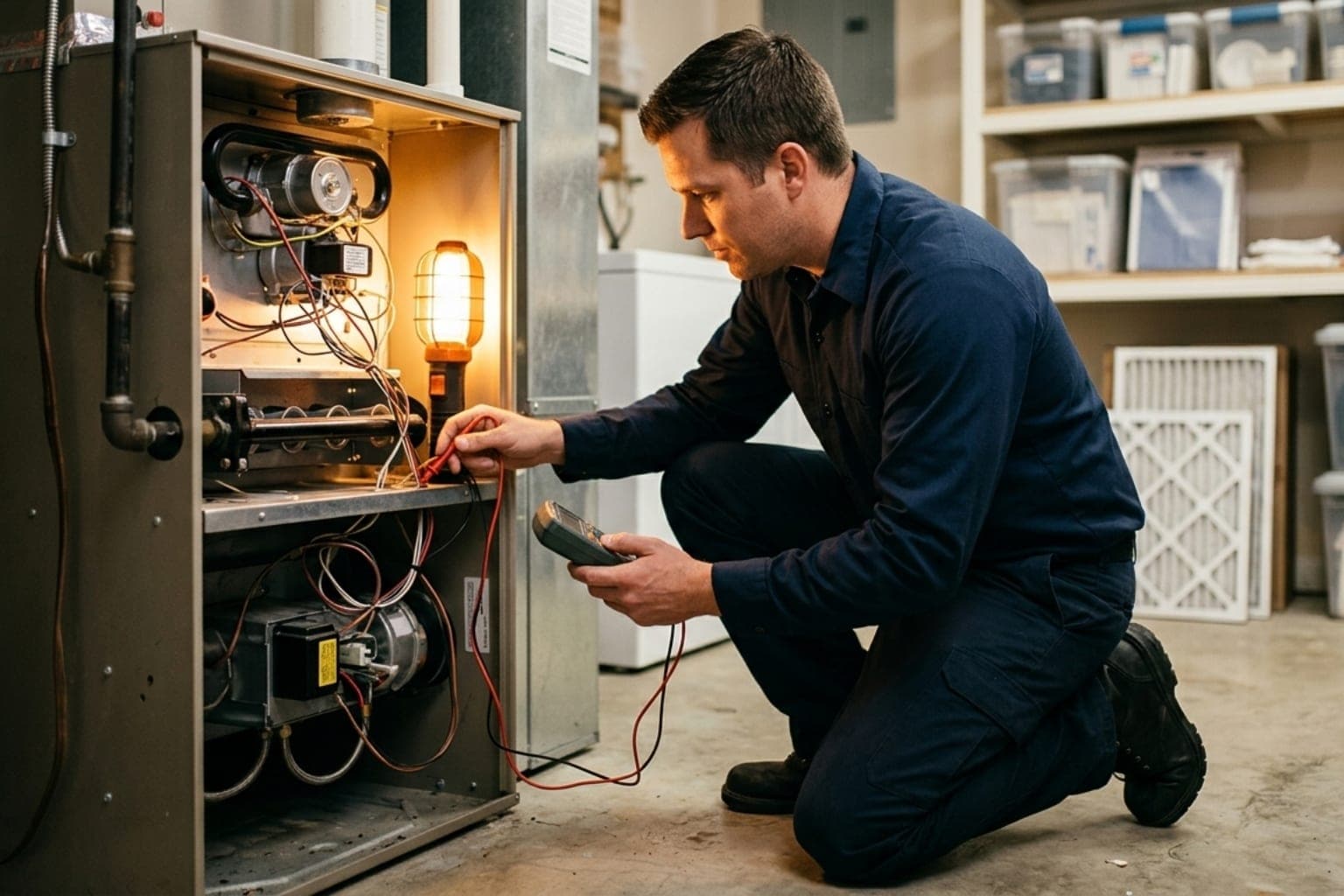
With the burner cover off, the technician watches the flames as the furnace fires. A healthy gas flame is steady and mostly blue, with maybe a small yellow tip. Yellow flames, lifting flames (jumping off the burner), or uneven flames between burners all point to combustion problems. They also clean and test the flame sensor (a thin metal rod that confirms the flame is actually burning; if it can't sense flame, the gas valve closes for safety). The igniter is tested with a multimeter to confirm it heats up correctly. Finally, a combustion analyzer reads what's coming out of the flue, which catches problems your eyes can't.
Airflow and Filter Inspection
The technician pulls the air filter and looks at it, then checks the return ducts (where air pulls back into the furnace) and the supply plenum (where heated air goes out). A clogged filter or blocked return is one of the top reasons a furnace overheats and shuts itself off. They'll measure static pressure (basically how hard the blower is working to push air) with a small gauge. High readings mean airflow is restricted, which strains the blower motor and shortens the furnace's life. The blower wheel itself gets inspected for dust buildup. A dirty blower throws off the balance and creates vibration noise.
Safety Switch Testing
Three safety switches inside your furnace shut it down if something goes wrong: the high-limit switch (trips on overheating), the rollout switch (trips if flames escape the burner area), and the pressure switch (trips if the exhaust fan isn't moving enough air). The technician tests each one. The important diagnostic point is that a tripping switch is a symptom, not the actual problem. Restricted airflow trips the high-limit, a cracked heat exchanger trips the rollout, a clogged drain line or blocked vent trips the pressure switch. A good technician traces the symptom back to the real cause instead of just resetting the switch.
Gas Pressure and Heat Exchanger Inspection
The technician hooks up a small pressure gauge to confirm the gas pressure feeding the furnace is correct. Too low and the furnace burns inefficiently. Too high and the furnace overfires, which damages the heat exchanger over time. They'll adjust the gas pressure to the manufacturer's spec, with the high-altitude derate applied for our elevation. Then they inspect the heat exchanger itself, using either a small camera (called a borescope) or a flashlight, looking for cracks, corrosion, or soot patterns. A cracked heat exchanger is the one finding that means replacement, regardless of how old the furnace is, because it can leak carbon monoxide into your home.
Carbon Monoxide Test
The combustion analyzer reads CO levels both inside the furnace at the burners (where the gas is burning) and at one of your supply registers (where heated air enters your home). High CO at the burner means the furnace isn't burning gas completely. CO showing up at the supply register is a much bigger problem. It means combustion gases are leaking into your indoor air, usually through a cracked heat exchanger or a venting issue. Utah code requires working CO alarms in homes with gas appliances, and the technician will confirm yours are functioning before leaving. If CO levels are dangerous, the furnace gets shut off and tagged until it's repaired.
Should You Repair or Replace? Two Simple Rules
If your technician quotes a big repair on an older furnace, you have a decision to make. Two simple rules help cut through the math. The 50% Rule says replace if the repair quote is more than half the cost of a new furnace. The 5,000 Rule says multiply the furnace's age by the repair cost. If it's over $5,000, lean toward replacement. When the two rules disagree, the older the furnace is, the stronger the case for replacing it.
The 50% Rule
If the repair quote is more than half the cost of a new furnace, replacement is usually the better long-term call. Example: a $3,000 heat exchanger replacement on a furnace that would cost $5,500 to fully replace fails the 50% test. Replacement makes more sense. A $300 igniter on the same furnace passes easily. The rule breaks down at the extremes (a $200 repair on a 25-year-old furnace still suggests replacing it; a $2,000 repair on a 5-year-old furnace still suggests fixing).
The 5,000 Rule
Multiply your furnace's age in years by the repair quote. If the result is over $5,000, get a replacement quote alongside the repair estimate. A 16-year-old furnace with a $350 repair scores 5,600, close to the line, so it's worth seeing both numbers before deciding. A 6-year-old furnace with the same repair scores 2,100, comfortably below the threshold. We have a fuller breakdown including new-furnace pricing on our furnace replacement page.
When Replacement Is the Right Answer Regardless of the Math
Some findings push you to replacement even when the rules suggest fixing. A cracked heat exchanger on any furnace 12 or more years old. Multiple major repairs in a single winter. Carbon monoxide showing up at your supply registers. Rising bills paired with rooms that never warm up evenly. These all signal a furnace at the end of its useful life, and even a moderate repair is essentially throwing good money after bad. The combustion analyzer reading at the diagnostic visit usually catches these problems before the repair quote even gets written.
Furnace Repair Cost in Utah: What to Expect
Furnace repair costs in Utah depend on the specific problem, the age and type of your furnace, and the parts required. Here is a breakdown based on data from our partner technicians across the Salt Lake City metro area.
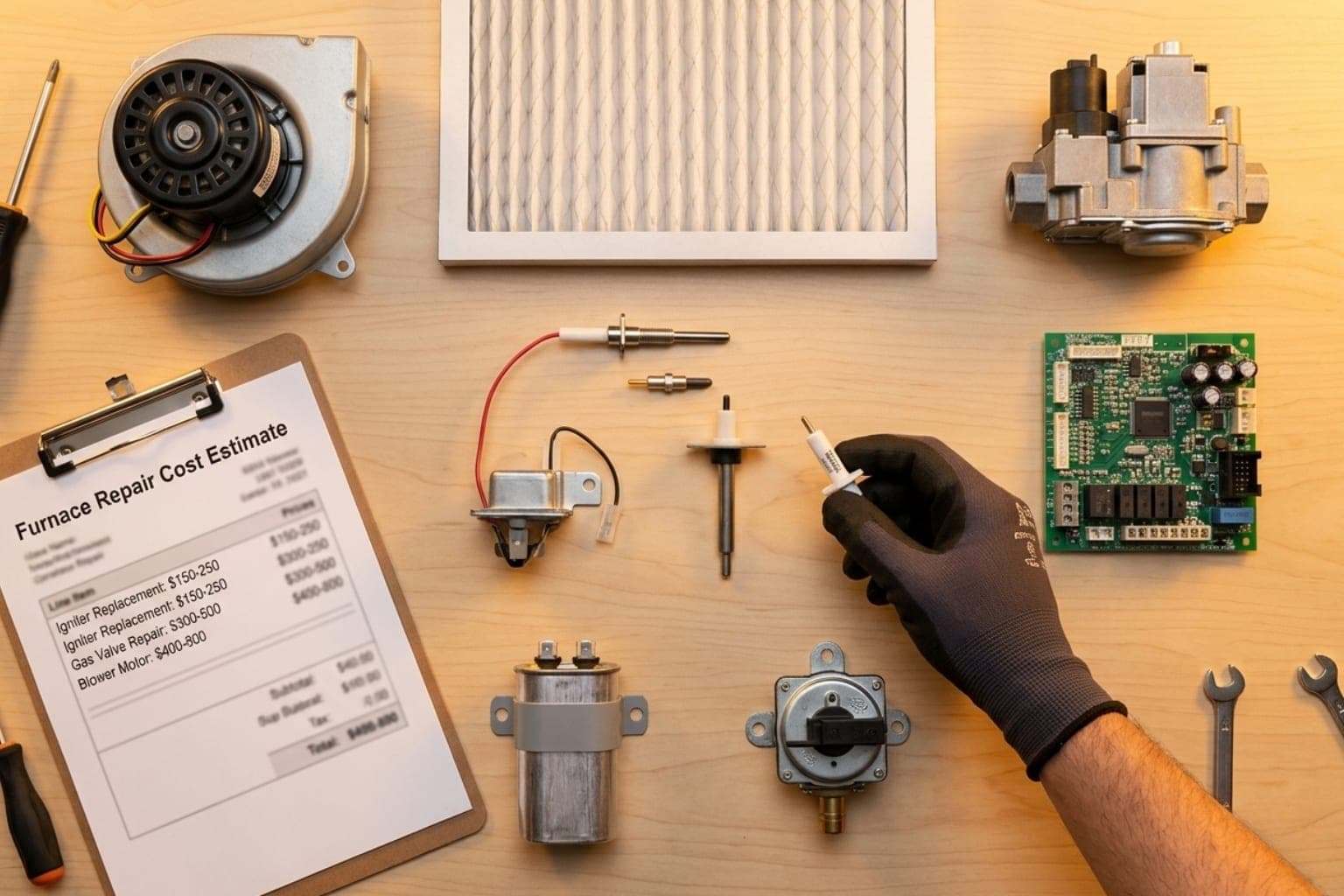
The diagnostic charge is bundled into your repair invoice when you authorize service, so the dispatch visit isn't a separate line item once the work is approved. The dispatcher walks you through pricing details when you call.
Minor repairs (flame sensor, igniter, thermocouple, air filter, blower belt): $100 to $300
Moderate repairs (blower motor, gas valve, control board, draft inducer motor): $300 to $700
Major repairs (heat exchanger, compressor, full blower assembly): $700 to $2,500
Costs above cover repair scope. For full furnace replacement pricing including AFUE-tier comparison and 2026 utility rebate stacking, see our furnace replacement page.
Utah's high altitude (4,265 to 6,000+ feet across the Wasatch Front) affects gas furnace combustion and requires technicians who understand altitude-specific gas pressure calibration. Our partner technicians are experienced with Utah's elevation requirements.
When to Schedule Furnace Repair in Utah
September through November is the ideal time for pre-season furnace inspections. Technician availability is high, and catching problems before the first hard freeze prevents emergency calls. We recommend scheduling a furnace tune-up every fall, especially for systems older than 10 years.
December through February is peak emergency season. When overnight lows drop below 20 degrees along the Wasatch Front, furnace failures become urgent. Wait times during cold snaps can stretch to 24 hours with other providers. Our network prioritizes emergency calls and typically responds within four to six hours even during peak demand.
March through May is an excellent time for non-urgent repairs and furnace replacements. Technician schedules are more flexible, and many of our partners offer off-season pricing on new installations.
How It Works
Getting matched with a trusted furnace technician is simple. Here's how we connect you with the right pro.
Tell Us Your Issue
Call us or fill out the form with details about your furnace problem. Same-day dispatch available.
Get Matched with a Tech
We connect you with a licensed, background-checked technician in your area. Usually within minutes.
Problem Solved
Your technician arrives, diagnoses the issue, and gets your heating system running. Written estimate before any work begins.
Need a Furnace Technician? We'll Match You in Minutes.
Call now or fill out our form to get connected with a licensed, background-checked heating technician in your area. Same-day availability in most locations.
DOPL-Licensed · Same-Day Dispatch · After-Hours Available
Why Homeowners Trust Us
We vet every technician in our network so you don't have to. Here's what sets our partner techs apart.
Licensed & Insured
Every technician in our network is state-licensed, fully insured, and background-checked for your peace of mind.
Same-Day Service
Most service calls are scheduled within 2-4 hours. Emergency dispatch available evenings, weekends, and holidays.
DOPL-Licensed Network
Every technician we connect you with carries an active Utah Division of Professional Licensing (DOPL) HVAC contractor license and full liability insurance. License status is verifiable through the Utah DOPL public lookup.
Transparent Estimates
You receive a written estimate before any work begins. The diagnostic charge is stated up front and rolls into your repair invoice once you approve the work, so there is no separate billing for the visit. No hidden charges, no surprise add-ons after the technician arrives.
What Utah Homeowners Say
Real reviews from homeowners we've connected with trusted local technicians.
“Our furnace died on the coldest night of the year. I called Utah Furnace Repair and they had a licensed tech at our door within 2 hours. He diagnosed the problem, had the part on his truck, and we had heat before bedtime. Incredible service.”
Sarah M.
Salt Lake City, UT
“I was quoted $4,000 by another company for a furnace replacement. Utah Furnace Repair connected me with a tech who found the real issue: a $200 igniter replacement. Honest, skilled, and saved me thousands.”
Mike T.
Sandy, UT
“From the phone call to the finished repair, the whole experience was seamless. The technician was on time, explained everything clearly, and left the work area spotless. I’ll be using this service for all my HVAC needs.”
Jennifer R.
West Valley City, UT
“We needed a new furnace installed in our home in SunCrest. The tech they matched us with was knowledgeable about high-altitude installations and did an outstanding job. Highly recommend.”
David L.
Draper, UT
“Scheduled a fall tune-up through Utah Furnace Repair. The technician was thorough, found a cracked heat exchanger we didn’t know about, and probably saved us from a dangerous situation. So grateful for the quality of their network.”
Lisa K.
Murray, UT
“Fast, professional, and affordable. The tech arrived exactly when they said he would, fixed our furnace in under an hour, and the price was very fair. This is how home services should work.”
Robert H.
Bountiful, UT
Furnace Repair FAQs
Service Areas Across Utah
Our network of licensed technicians serves communities throughout the Salt Lake City metro and beyond.
Salt Lake City
Salt Lake County
200,000+ residents
Sandy
Salt Lake County
96,000+ residents
Draper
Salt Lake County
51,000+ residents
West Valley City
Salt Lake County
140,000+ residents
West Jordan
Salt Lake County
116,000+ residents
South Jordan
Salt Lake County
77,000+ residents
Murray
Salt Lake County
50,000+ residents
Midvale
Salt Lake County
35,000+ residents
Taylorsville
Salt Lake County
60,000+ residents
Bountiful
Davis County
44,000+ residents
Layton
Davis County
82,000+ residents
Ogden
Weber County
87,000+ residents
Herriman
Salt Lake County
55,000+ residents
Riverton
Salt Lake County
45,000+ residents
Other Heating Services
Our network of partner technicians covers all your heating needs.
Furnace Installation
Licensed installers across the Wasatch Front. Free in-home estimates with sizing for altitude and ductwork compatibility.
Learn More →Furnace Maintenance
Keep your heating system running efficiently. Our partner techs perform 21-point inspections.
Learn More →Emergency Heating Repair
No heat? We dispatch a licensed technician to your home fast. Available nights, weekends, and holidays.
Learn More →Heater Repair
Gas, electric, or heat pump. Our partner techs handle all heater types. Same-day service across Salt Lake City metro.
Learn More →Heat Pump Repair
Our partner technicians are trained on all major heat pump brands. Diagnosis and repair in one visit.
Learn More →Furnace Replacement
Licensed installers across the Wasatch Front. Right-sized AFUE selection, current ThermWise rebate stacking, and same-day estimates.
Learn More →Gas Furnace Repair
Gas furnace issues require certified technicians. Our partners are licensed for gas line work and furnace diagnostics.
Learn More →Boiler Repair
Boilers require specialized knowledge. Our partner techs handle steam, hot water, and radiant systems.
Learn More →