Heater Repair for Every System Type in Utah
Gas, electric, or heat pump. Our partner techs handle all heater types. Same-day service across Salt Lake City metro.
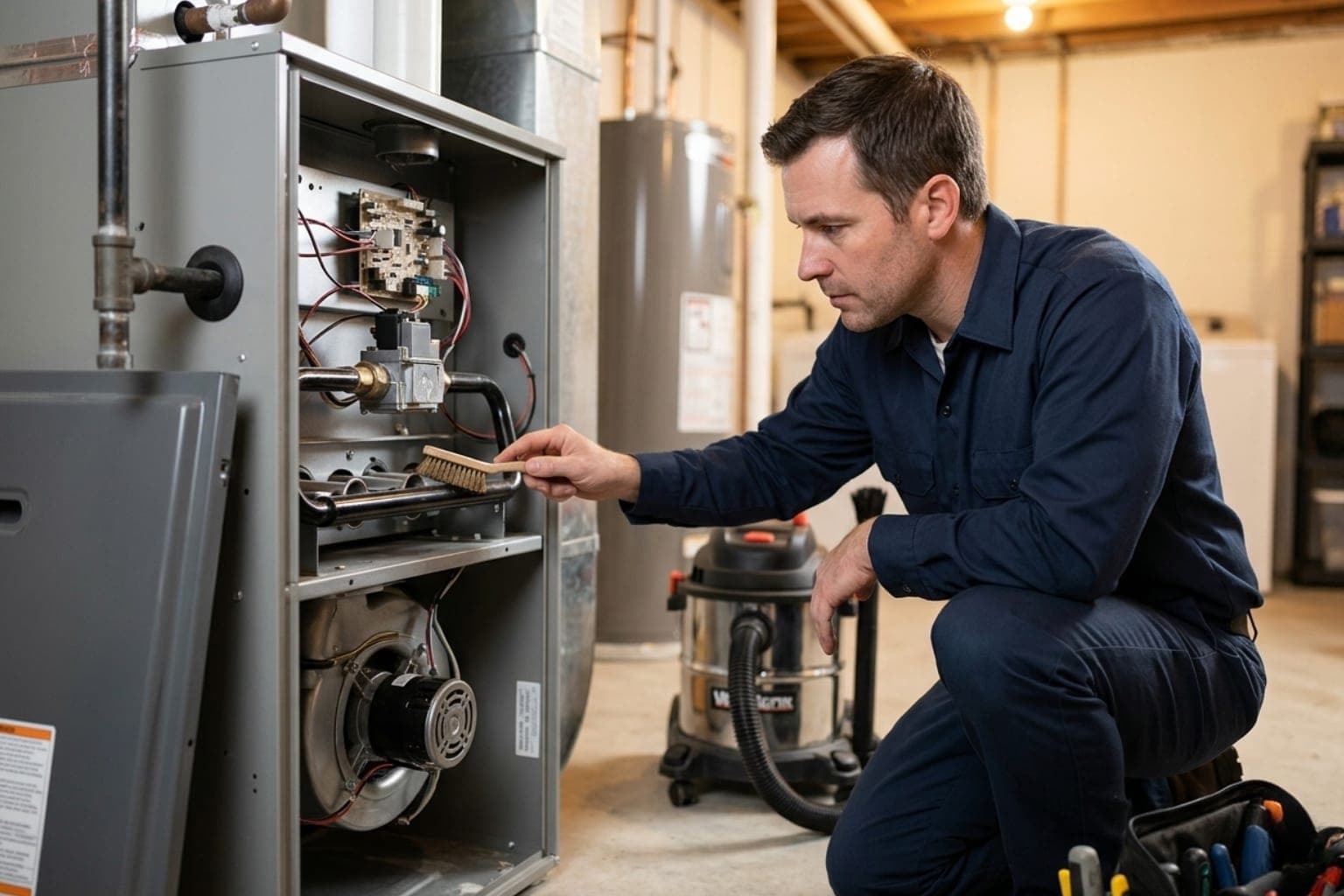
Utah Furnace Repair connects homeowners with licensed technicians who service every type of heating system, not just gas furnaces. If your heater stopped working and you are not certain whether you have a furnace, boiler, heat pump, or something else, the System Identifier below will narrow it down in about a minute. Our technicians are DOPL-licensed, insured, and trained across system types. Most repair calls are matched within fifteen minutes of contact.
Not Sure What Kind of Heater You Have? Three Things to Check
Most homeowners do not know what kind of heating system they have until something breaks. That is normal. The label is often hidden, the previous owner did not pass it on, and the original manuals are long gone. The fastest way to identify your system is to look at three things: the equipment itself, the thermostat, and your utility bill. Each gives a different signal, and together they almost always pin down what you have.
1. Find Your Heating Equipment and Look at It
Walk to wherever your heating equipment lives. In Utah homes that is usually the basement, attic, garage, or a utility closet. What you see narrows the system down quickly.
A metal cabinet with a flue pipe going up through the roof and air ducts running out into the rest of the house means you have a furnace. Most Utah furnaces run on natural gas; a smaller share are electric. For deep diagnostics, see our Furnace Repair page.
A pressure vessel or tank with copper pipes running to radiators or baseboards along the walls means you have a boiler. Hot water boilers are more common in Utah; steam boilers exist in some pre-1940 Avenues and Capitol Hill homes. See our Boiler Repair page.
A wall-mounted unit in each room with an outdoor compressor unit, but no central ductwork, means you have a ductless mini-split. These work in both heating and cooling modes.
Long, low metal heaters running along the base of walls, with their own dial or a wall thermostat, mean you have electric baseboard heat. No ducts, no flue, just resistance heating.
A square box mounted on a wall with louvers or vents, heating only the room it is in, means you have a wall heater. Could be gas or electric.
An outdoor unit that runs in winter and looks like an air conditioner but is doing the heating work means you have a heat pump. Often paired with a gas furnace as a hybrid (dual-fuel) system in Utah climates.
Warm floors with no visible heaters in the rooms, and tubing visible in a mechanical room or under a hatch, mean you have radiant floor heating, which is structurally a boiler system.
2. Check Your Thermostat
The thermostat gives a strong second signal. If your thermostat has an Emergency Heat or Aux Heat setting, you have a heat pump. The aux mode exists because heat pumps lose efficiency at cold temperatures and need backup electric resistance heat (or, in dual-fuel setups, a gas furnace) when outdoor temperatures drop too low. If you see only Heat, Cool, and Off modes with no auxiliary settings, you most likely have a furnace, boiler, or simple electric heat. Smart thermostats are system-agnostic but usually identify the system type during their initial setup screens, which you can revisit through the device's settings.
3. Check Your Utility Bill
Your utility bill is the third signal. A natural gas line item from Enbridge Gas (formerly Dominion Energy) with high winter usage means gas heat: most likely a gas furnace, gas boiler, or gas wall heater. An electric-only bill where kWh consumption doubles or triples in winter compared to summer points to electric resistance heating (electric furnace, baseboard, or wall heaters) or a heat pump. Heat pumps generally use less electricity than pure resistance heat at the same heating load, so a heat pump home will see a smaller winter spike than an all-resistance home.
Still Stumped? Send Us a Photo
If you have checked the equipment, thermostat, and bill and you still are not certain what you have, fill out the contact form below. One of our technicians will follow up by text and identify your system from a photo before we dispatch. We would rather get the right tech for the right system on the first visit than guess and reschedule.
Heater Repair by System Type
Once you know what you have, the right repair approach depends on the system. Here is what we cover for each, with links to the deep troubleshooting and pricing pages where they exist.
Gas and Electric Furnaces
Gas furnaces are the most common heating system in Utah homes. Roughly seven in ten Wasatch Front houses run a forced-air gas furnace. Common failures include hot surface igniters, which typically last six to twelve years and are the most-replaced component during peak winter months. Flame sensors get fouled by carbon buildup from continuous January operation. Blower motor bearings wear from running for days at a time during cold snaps. Cracked heat exchangers appear in older systems and create carbon monoxide risk that requires immediate attention.
Electric furnaces are less common in Utah but show up in some all-electric homes, especially in newer South Jordan and Herriman builds where extending natural gas service was an upgrade cost. Their failure modes involve heating elements, sequencer relays, and high-limit switches rather than ignition components.
If you have confirmed you have a forced-air furnace, the deep diagnostic and pricing guide is at our Furnace Repair page, with component-level repair costs and seasonal timing data.
Boilers (Hot Water and Steam)
Boilers heat water and circulate it through radiators, baseboards, or in-floor tubing. They are more common in older Utah neighborhoods. The Avenues, Federal Heights, Capitol Hill, and parts of Sugar House have a high concentration of original 1900s-1940s hydronic systems that were installed before forced air became standard.
Common boiler failures include circulator pump failure (the pump that moves hot water through the heating loops), zone valve failure (which controls which rooms or zones get heat), expansion tank waterlogging, low-pressure shutdowns from a leak somewhere in the loop, kettling sounds from mineral buildup on the heat exchanger, and pilot or ignition failures on gas-fired units. Steam boilers add their own failure modes: clogged sight glasses, pressuretrol issues, and water-feeder valve problems.
For deep boiler diagnostics and pricing, see our Boiler Repair page.
Heat Pumps (Air-Source)
Heat pumps are growing in Utah but face altitude and cold-climate challenges. The Wasatch Front winter regularly drops below the temperature where a standard heat pump can pull enough heat from outdoor air, which is why most Utah heat pump installations are dual-fuel: heat pump for moderate temperatures, gas furnace backup for cold snaps below about twenty-five degrees.
Common heat pump failures include reversing valves that stick (the unit will not switch from cooling to heating mode), defrost cycle problems (the outdoor unit ices over and cannot shed it), refrigerant leaks at flare connections or in the indoor coil, capacitor failures on the outdoor unit, and aux heat strips that will not engage when the heat pump cannot keep up. If your heat pump runs constantly without warming the house, the issue is usually a stuck reversing valve or a failure in the aux heat backup.
For heat pump-specific troubleshooting, see our Heat Pump Repair page.
Ductless Mini-Splits
Mini-splits are ductless heat pumps with one or more wall-mounted indoor units. They are popular in Utah additions, accessory dwelling units, and homes that lack existing ductwork. They run as heat pumps in heating mode and share most failure modes with ducted heat pump systems, plus a few that are specific to the ductless configuration.
Mini-split-specific failures include indoor unit drain pan leaks (water drips from the wall unit, often after long cooling-mode use that left condensate behind), sensor errors that report incorrect indoor temperatures and cause the system to over- or under-shoot, communication errors between indoor and outdoor units across the wiring run, refrigerant line damage at the wall penetration, and outdoor fan failures. In multi-zone systems, one zone going out while others continue working usually points to a zone-specific control board or sensor rather than a whole-system problem.
The closest specialist coverage for mini-split repair is our Heat Pump Repair page, which covers the underlying refrigerant and reversing-valve diagnostics that apply to both ducted and ductless systems.
Radiant Floor and Hydronic Heating
Radiant floor heating uses heated water circulating through tubing under the floor, which makes it structurally a boiler system. The boiler itself follows the failure modes covered in the boiler section above. Radiant-specific failures show up in the manifold (the distribution hub where individual loops branch off into different zones), the circulator pumps (separate pumps for each zone in larger systems), and the loops themselves (which can develop air locks or, rarely, leaks at fittings).
The most common complaint with radiant systems is uneven heating: one zone or one room runs cold while the others are fine. That almost always points to a manifold balancing valve issue or a stuck circulator pump on that loop, rather than a problem with the boiler. The closest specialist coverage for the underlying boiler is our Boiler Repair page. Radiant-specific manifold work is something our technicians handle on the same call.
Electric Baseboard and Wall Heaters
Electric baseboard and wall heaters use simple resistance heating: electricity passes through a heating element and the element warms up. They are failure-resistant for the most part. When something does break, it is almost always one of three things.
The thermostat goes out, either the unit's built-in dial thermostat or the wall-mounted one in the room. Replacement is straightforward and inexpensive. The heating element itself fails, which shows up as a permanent cold spot on a unit that is otherwise running. The breaker trips repeatedly, usually from a short in the element or, less commonly, from a wiring issue at the unit's connection point.
Wall heaters add one failure mode that baseboards do not: gas wall heaters can develop pilot light issues, gas valve failures, or ventilation blockages. If your wall heater has a flame in it (rather than just a glowing element), it is gas, and the safety implications are the same as a gas furnace. Yellow flames or any soot buildup means call before running it again.
Garage and Shop Heaters
Garage and shop heaters, typically Modine, Reznor, or Mr. Heater hanging-style units, use direct gas combustion to heat large open spaces. Failure modes are similar to gas furnaces but in a more punishing environment: heavy dust intake, vehicle exhaust contamination, and freeze-thaw cycling on the combustion chamber.
Common failures include ignition control board failures (especially in units that sit unused for long stretches between cold seasons), flame sensor fouling at a much faster rate than residential furnaces because of the dirty environment, gas pressure issues at the manifold, and venting blockages from bird nests or debris in seasonal-use units. We service all major brands of standard hanging unit heaters.
Older and Oil-Fired Systems
Oil-fired heating is uncommon in Utah but not extinct. Some older homes in The Avenues, Federal Heights, and Foothill, particularly those that were built before natural gas service reached the neighborhood and never converted, still run oil furnaces or oil boilers.
Oil systems have unique failure modes: nozzle clogs from sludge in the tank, fuel pump failures, ignition transformer issues, and chimney or flue problems specific to oil combustion. We service them, and we can also estimate a conversion to gas (or, in some cases, to a heat pump) if your system is reaching end of life and an oil delivery contract no longer makes financial sense.
Top Signs Your Heater Needs Repair (Any System)
These symptoms apply across system types. The diagnosis depends on what you have, but the signal that something is wrong cuts across all heaters.
Insufficient or No Heat
Set point is correct but the house is not reaching temperature, or there is no heat at all. On a furnace, this often means a failed igniter, flame sensor, or gas valve. On a boiler, it points to circulator pump failure, low water pressure, or an aquastat issue. On a heat pump, it usually means the reversing valve is stuck or the auxiliary heat is not engaging. On baseboards or wall heaters, it is most often a thermostat or a failed element.
Cold Air, Cold Radiators, or Cold Spots in the Floor
Forced-air systems blow cold air when the burner has shut down but the blower has not. This is usually a high-limit trip from overheating, often caused by a clogged filter that restricted airflow. Boilers have cold radiators when air is trapped in the loop or when a zone valve has failed. Radiant floor systems develop cold spots from manifold imbalance or a stuck loop circulator pump. Heat pumps in heat mode that blow cool air through the vents almost always have a reversing-valve problem.
Strange Noises (and What Each Sound Means)
Sound is one of the most diagnostic symptoms in heating equipment. Banging on startup is usually delayed ignition on a gas furnace, which means dirty burners or a gas pressure problem. Do not ignore it. Delayed ignition can crack the heat exchanger.
Screeching or squealing is almost always a blower motor bearing or a slipping belt on older furnaces, or a circulator pump bearing on a boiler.
Kettling, the popping or knocking sound from inside a boiler that resembles a tea kettle, means mineral buildup on the heat exchanger from hard Utah water.
Gurgling means air trapped in a boiler loop or an issue with an open expansion tank.
Clicking with no ignition is a failed igniter on a furnace, or a failed ignition module on a gas boiler or wall heater.
Constant fan running with no heat is a limit switch issue, or a thermostat wired to fan-on instead of auto.
Yellow Flame, Gas Smell, or Soot Buildup (Safety Callout)
If you have a gas-fired system (furnace, boiler, wall heater, garage heater) and you see a yellow flame instead of blue, or smell gas, or see soot around the unit, stop using it and call. A yellow flame indicates incomplete combustion, which produces carbon monoxide. A gas smell can mean a leak in the supply line, the gas valve, or a cracked heat exchanger. We treat these as same-day priority calls and dispatch with combustion analyzers. If a CO detector goes off, leave the home and call 911 first, then call us.
Short-Cycling
The heater turns on, runs briefly, shuts off, and repeats multiple times per hour. On a furnace, this is usually a high-limit trip from overheating (clogged filter, blocked return air, failed blower) or a flame sensor that is losing the flame mid-cycle. On a boiler, it points to an aquastat misadjustment or a low-water-cutoff issue. On a heat pump, it can mean low refrigerant or a failing capacitor.
Energy Bills Suddenly Higher
A sudden twenty-percent-or-more jump in winter energy use, with no rate change from your utility, almost always means the heater is running longer than it should. Causes include a failing component making the system work harder (a partially blocked heat exchanger, a slipping blower belt, a refrigerant leak in a heat pump), a duct leak that lets heated air escape into the attic instead of into rooms, or a thermostat sensor problem that causes overshoot.
Heater Is Over Fifteen Years Old
At fifteen-plus years, every heating system is in repair-versus-replace territory. Furnaces typically last fifteen to twenty years. Heat pumps last twelve to fifteen. Boilers last fifteen to thirty (boilers are the longest-lived heating equipment, but their failure points get expensive). Mini-splits last twelve to fifteen. The decision framework is in the next section.
Heater Repair Cost in Utah
Repair cost varies more by system type than by city. Here is what most repairs run statewide. If you proceed with the repair, the diagnostic visit is credited against the work, so there's no double payment.
Furnace igniter replacement: $150 to $300
Furnace flame sensor service: $80 to $200
Furnace blower motor: $400 to $800
Furnace control board: $500 to $1,200
Boiler circulator pump: $400 to $900
Boiler zone valve: $200 to $400
Boiler expansion tank: $300 to $600
Heat pump capacitor: $150 to $400
Heat pump reversing valve: $600 to $1,500
Heat pump compressor: $1,500 to $3,500
Mini-split control board: $400 to $900
Electric baseboard thermostat: $80 to $200
Electric baseboard heating element: $150 to $350
Wall heater thermocouple: $100 to $250
Garage heater ignition control: $300 to $600
Full furnace replacement: $3,500 to $8,000+
Full boiler replacement: $5,500 to $14,000+
Full heat pump replacement: $5,000 to $12,000+
Repair vs. Replace: The 5000 Rule
When the technician's diagnosis quotes a major repair on an aging heater, you face the repair-vs-replace decision. The industry-standard 5000 Rule applies: multiply the system's age in years by the estimated repair cost; if the result exceeds $5,000, replacement usually delivers better long-term value. Lifespan baselines vary by system type (heat pumps fail faster, boilers last longer), as does rebate stacking math. The full system-by-system decision framework, AFUE-tier replacement economics, and current Enbridge Gas / Rocky Mountain Power rebate stacking all live on our furnace replacement page.
Same-Day and After-Hours Emergency Heater Repair in Utah
Emergency dispatch is available statewide, twenty-four hours a day, including weekends and holidays. During standard hours we typically arrive within two to four hours. During December through February peak demand the window extends to four to six hours. Emergency calls are prioritized: no-heat with vulnerable residents, gas smell, or a triggered carbon monoxide alarm move ahead of routine calls.
Service area covers Salt Lake County, Davis County, Weber County, and Utah County. Key cities include Salt Lake City, Sandy, Draper, West Valley City, West Jordan, South Jordan, Murray, Midvale, Taylorsville, Bountiful, Layton, Ogden, Herriman, and Riverton.
How It Works
Getting matched with a trusted furnace technician is simple. Here's how we connect you with the right pro.
Tell Us Your Issue
Call us or fill out the form with details about your furnace problem. Same-day dispatch available.
Get Matched with a Tech
We connect you with a licensed, background-checked technician in your area. Usually within minutes.
Problem Solved
Your technician arrives, diagnoses the issue, and gets your heating system running. Written estimate before any work begins.
Need a Furnace Technician? We'll Match You in Minutes.
Call now or fill out our form to get connected with a licensed, background-checked heating technician in your area. Same-day availability in most locations.
DOPL-Licensed · Same-Day Dispatch · After-Hours Available
Why Homeowners Trust Us
We vet every technician in our network so you don't have to. Here's what sets our partner techs apart.
Licensed & Insured
Every technician in our network is state-licensed, fully insured, and background-checked for your peace of mind.
Same-Day Service
Most service calls are scheduled within 2-4 hours. Emergency dispatch available evenings, weekends, and holidays.
DOPL-Licensed Network
Every technician we connect you with carries an active Utah Division of Professional Licensing (DOPL) HVAC contractor license and full liability insurance. License status is verifiable through the Utah DOPL public lookup.
Transparent Estimates
You receive a written estimate before any work begins. The diagnostic charge is stated up front and rolls into your repair invoice once you approve the work, so there is no separate billing for the visit. No hidden charges, no surprise add-ons after the technician arrives.
What Utah Homeowners Say
Real reviews from homeowners we've connected with trusted local technicians.
“Our furnace died on the coldest night of the year. I called Utah Furnace Repair and they had a licensed tech at our door within 2 hours. He diagnosed the problem, had the part on his truck, and we had heat before bedtime. Incredible service.”
Sarah M.
Salt Lake City, UT
“I was quoted $4,000 by another company for a furnace replacement. Utah Furnace Repair connected me with a tech who found the real issue: a $200 igniter replacement. Honest, skilled, and saved me thousands.”
Mike T.
Sandy, UT
“From the phone call to the finished repair, the whole experience was seamless. The technician was on time, explained everything clearly, and left the work area spotless. I’ll be using this service for all my HVAC needs.”
Jennifer R.
West Valley City, UT
“We needed a new furnace installed in our home in SunCrest. The tech they matched us with was knowledgeable about high-altitude installations and did an outstanding job. Highly recommend.”
David L.
Draper, UT
“Scheduled a fall tune-up through Utah Furnace Repair. The technician was thorough, found a cracked heat exchanger we didn’t know about, and probably saved us from a dangerous situation. So grateful for the quality of their network.”
Lisa K.
Murray, UT
“Fast, professional, and affordable. The tech arrived exactly when they said he would, fixed our furnace in under an hour, and the price was very fair. This is how home services should work.”
Robert H.
Bountiful, UT
Heater Repair FAQs
Service Areas Across Utah
Our network of licensed technicians serves communities throughout the Salt Lake City metro and beyond.
Salt Lake City
Salt Lake County
200,000+ residents
Sandy
Salt Lake County
96,000+ residents
Draper
Salt Lake County
51,000+ residents
West Valley City
Salt Lake County
140,000+ residents
West Jordan
Salt Lake County
116,000+ residents
South Jordan
Salt Lake County
77,000+ residents
Murray
Salt Lake County
50,000+ residents
Midvale
Salt Lake County
35,000+ residents
Taylorsville
Salt Lake County
60,000+ residents
Bountiful
Davis County
44,000+ residents
Layton
Davis County
82,000+ residents
Ogden
Weber County
87,000+ residents
Herriman
Salt Lake County
55,000+ residents
Riverton
Salt Lake County
45,000+ residents
Other Heating Services
Our network of partner technicians covers all your heating needs.
Furnace Repair
We connect you with licensed, background-checked heating pros in your area. Same-day appointments available.
Learn More →Furnace Installation
Licensed installers across the Wasatch Front. Free in-home estimates with sizing for altitude and ductwork compatibility.
Learn More →Furnace Maintenance
Keep your heating system running efficiently. Our partner techs perform 21-point inspections.
Learn More →Emergency Heating Repair
No heat? We dispatch a licensed technician to your home fast. Available nights, weekends, and holidays.
Learn More →Heat Pump Repair
Our partner technicians are trained on all major heat pump brands. Diagnosis and repair in one visit.
Learn More →Furnace Replacement
Licensed installers across the Wasatch Front. Right-sized AFUE selection, current ThermWise rebate stacking, and same-day estimates.
Learn More →Gas Furnace Repair
Gas furnace issues require certified technicians. Our partners are licensed for gas line work and furnace diagnostics.
Learn More →Boiler Repair
Boilers require specialized knowledge. Our partner techs handle steam, hot water, and radiant systems.
Learn More →