Annual Furnace Maintenance by Certified Utah Technicians
Preventive furnace maintenance catches small problems before they become expensive emergency repairs. Our partner technicians perform comprehensive 21-point inspections that keep your heating system running safely and efficiently all winter.
Why Furnace Maintenance Matters in Utah
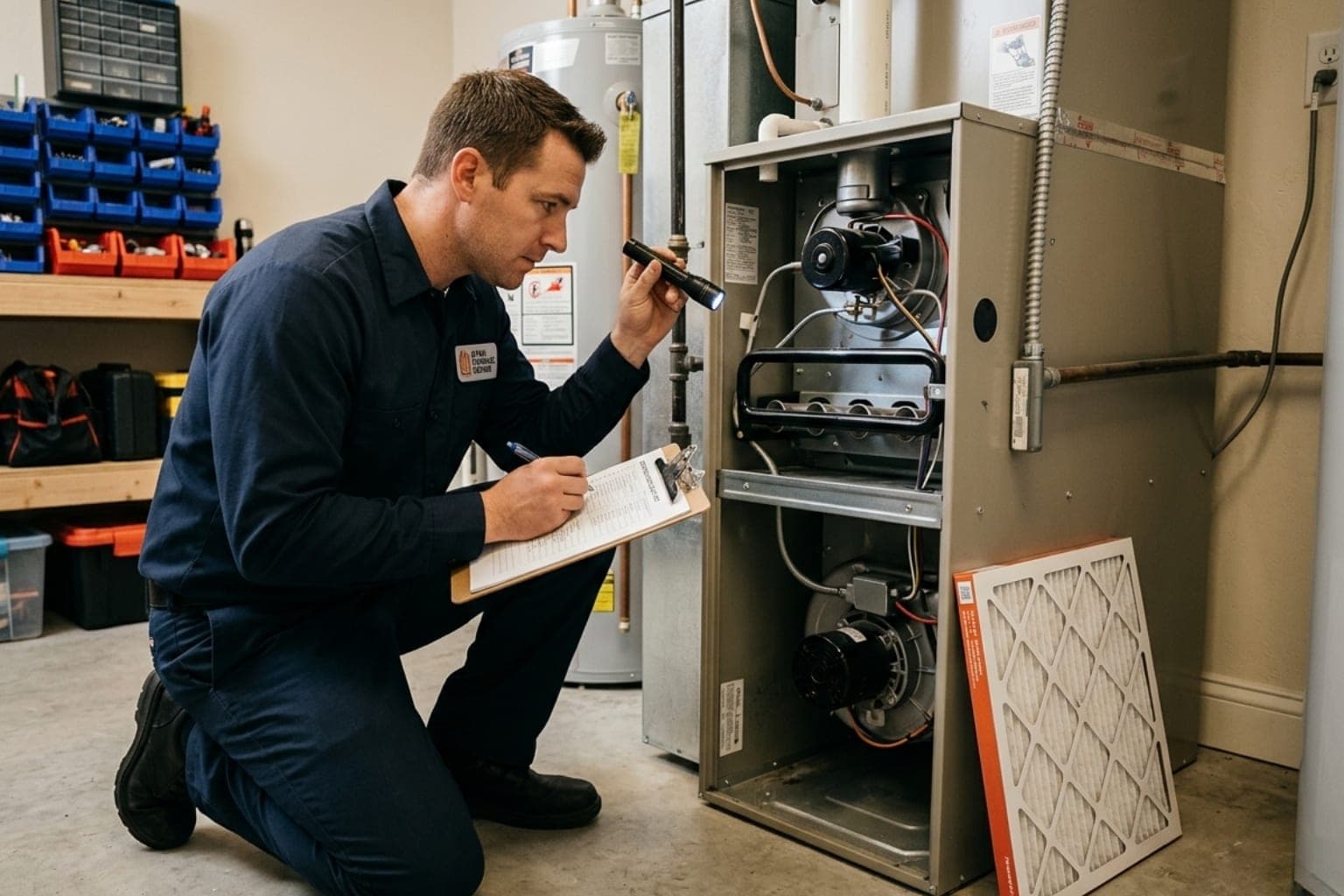
Utah's heating season runs roughly six months, from October through March. During that time, your furnace cycles thousands of times, burning natural gas and pushing heated air through your ductwork. Without annual maintenance, components wear, efficiency drops, and the risk of mid-winter breakdowns increases significantly.
The numbers support annual maintenance. According to HVAC industry data, furnaces that receive annual professional maintenance last 5 to 10 years longer than neglected systems, experience 95% fewer emergency breakdowns, maintain 15 to 20% higher energy efficiency over their lifespan, and retain higher resale value if you sell your home.
Utah Furnace Repair connects you with certified technicians who perform thorough furnace tune-ups across the Salt Lake City metro area. Every inspection follows a standardized 21-point checklist designed to catch problems early, restore efficiency, and verify safe operation.
What a Furnace Tune-Up Includes
Our partner technicians follow a comprehensive 21-point inspection protocol:
Safety Checks (Heat Exchanger, CO, and Venting)
The most important part of any tune-up is making sure your furnace is safe. The technician inspects the heat exchanger (the metal chamber inside the furnace where the burner heats the air) for cracks or pitting. Early damage usually shows up at the bottom of the chamber where moisture pools. They'll also test the high-limit switch and rollout safety switch (two automatic shutoffs that protect you and the equipment), confirm the flue is venting properly, and run a carbon monoxide test at both the flue and inside your living space.
If the visual heat exchanger inspection turns up anything concerning, a deeper inspection (using a small camera called a borescope or thermal imaging) can be done as a follow-up. That's covered on our gas furnace repair page.
Combustion Check and Altitude Calibration
Utah's elevation means your furnace has to be tuned to burn correctly with thinner air. The technician confirms the gas pressure feeding the burners is still set correctly using a small gauge (called a manometer). Gas pressure drifts a little over time as the gas valve ages, so this check matters every year. They'll also use a combustion analyzer (a meter that reads what's coming out of the flue) to verify the carbon monoxide and carbon dioxide levels are where they should be.
If the gas pressure has drifted enough to need adjusting, the technician handles it during the visit. The full altitude calibration setup, including orifice kits and the math behind the adjustments, is detailed on our gas furnace repair page.
Inspecting the Moving Parts
The mechanical check covers the parts most likely to wear out year over year: the blower motor (the fan that pushes heated air through your house), the blower wheel itself, the inducer motor (a smaller fan that pulls combustion gases up the flue, on high-efficiency units), and the ductwork connections at the furnace.
The technician uses a clamp meter (a tool that measures electrical current without disconnecting wires) to check whether the blower motor is drawing more power than it should. A reading 5 to 10 percent over normal usually means the bearings are starting to wear; 15 percent over often means failure is coming soon. On modern variable-speed motors, the technician can read diagnostic codes from the furnace's control board. Cleaning a normally dusty blower wheel is included in the tune-up; if the wheel needs heavy cleaning, the technician confirms the additional cost before doing the work.
Cleaning and Filter Replacement
Annual cleaning hits the parts that collect dust, debris, and combustion residue over a winter. The technician swaps the air filter (size and rating per your system, with our inversion-season guidance below), uses compressed air to clean the burner assembly, cleans the flame sensor with fine emery cloth (the flame sensor is a thin metal rod that confirms the flame is lit; oxidation builds up over a season and can prevent it from working), and cleans the blower compartment.
On high-efficiency furnaces (90%+), the technician also flushes the condensate drain and trap to keep them from clogging with biofilm or mineral buildup. Standard filter replacement is included with the tune-up. If you want to upgrade to a premium MERV 13+ or HEPA filter, that runs $25 to $75 additional depending on filter type and size.
Electrical Testing
The electrical check makes sure all the controls and safety circuits are working correctly. The technician confirms the thermostat is calibrated and switching the furnace on and off properly. They tighten wiring at the control board (loose wires cause intermittent failures that are hard to diagnose later). They test the capacitor (a small electrical part that helps the blower motor start, which weakens with age and is one of the most common failure points). And they verify the low-voltage transformer is delivering proper voltage to the controls.
A weakening capacitor is the single most common cause of a furnace electrical failure, and it's also one of the cheapest things to fix proactively. About $150 to $300 during a scheduled tune-up. Catching it during maintenance is much cheaper than the emergency repair when the furnace won't start on a cold January night.
Why Your Furnace Needs an Annual Altitude Check
When a gas furnace is first installed in Utah, the gas pressure has to be adjusted for our elevation (because the air is thinner at altitude). That setting can drift over time. Seasonal weather changes nudge it, the gas valve's internal spring weakens with age, and combustion residue slowly builds up on the brass nozzles (called orifices) that meter the gas. The annual maintenance visit confirms the original calibration is still holding within spec. If it's drifted, the technician resets it during the same visit, which prevents wasted gas, early heat exchanger damage, and elevated carbon monoxide output.
What Causes the Calibration to Drift
Three things shift the calibration between annual visits. First, seasonal atmospheric pressure changes. Utah's winter air is 1 to 2 percent denser than summer air, which changes how the burner reacts. Second, the gas valve itself: there's a small spring inside that holds gas pressure steady, and it slowly weakens with age, allowing pressure to creep up. Third, the burner orifices accumulate microscopic combustion residue over many heating seasons, which can restrict gas flow.
A small drift of less than 1 percent is normal seasonal noise. Drift above 3 percent means the calibration isn't holding properly. The technician figures out which of the three causes is driving the drift during your annual visit, and recommends the right fix, which is usually a simple adjustment.
What the Technician Actually Measures
The annual altitude check is three measurements. First, the gas pressure feeding the burners is read with a small gauge (3.5 inches of water column is the typical target for natural gas, with the altitude derate applied). Second, a combustion analyzer reads what's coming out of the flue during steady-state firing. Carbon monoxide, oxygen, and carbon dioxide all need to be within the manufacturer's spec. Third, the technician visually inspects the burner orifices for any deposits or partial blockage.
If your home was originally installed with a high-altitude orifice kit (standard for Park City and Heber elevations), the technician confirms the kit is still in place and the orifices are clean. The full altitude calibration setup is detailed on our gas furnace repair page.
What Happens If Recalibration Is Needed
If the readings show the calibration has drifted beyond spec, the technician handles recalibration during the same visit. No separate service call needed. The standard fix is a small adjustment to the gas valve, a recheck with the combustion analyzer, and a visual confirmation that the flame looks right.
The technician quotes recalibration as its own line item before adjusting anything, so you know what it costs before the wrench comes out. If the drift turns out to be a failed gas valve rather than a simple adjustment, the work escalates to gas valve replacement ($200 to $600 installed). Replacement is rare during routine maintenance. Most calibration issues are simple drift the technician can dial back in within minutes.
How Salt Lake's Hard Water Affects Your Furnace at Tune-Up Time
Salt Lake City water has a lot of dissolved minerals (calcium and magnesium, called hardness). It hits boilers harder than furnaces, since boilers actually circulate water through the system (more on that on our boiler repair page). But forced-air furnaces aren't immune. Hard water shows up in three places on a furnace: the condensate drain on high-efficiency models, your whole-home humidifier (if you have one), and very slightly on the heat exchanger itself. The annual tune-up catches each of these before they cause a problem.
How Hard Is Salt Lake City Water?
Salt Lake water averages around 13 grains per gallon (gpg) of dissolved minerals, which is classified as “very hard” by industry standards. Bench neighborhoods like the Avenues and Federal Heights run higher, often 15 to 20 gpg, partly because of older supply piping that adds minerals along the way. The exact number varies by neighborhood and even by individual home depending on the age of the pipes feeding it.
For your furnace, the three places hardness causes problems are: the condensate drain (mineral buildup can clog the drain on a high-efficiency furnace and trip its safety shutoff), your whole-home humidifier (mineral scale clogs the wet pad and the small valve that feeds it water), and very slightly the heat exchanger (mineral content in the indoor air can accelerate surface oxidation over many years).
Inspecting the Condensate Drain and Heat Exchanger
On high-efficiency furnaces (90% and up), the technician inspects the small drain line and trap that handles condensate (the small amount of water the furnace produces as it runs). Mineral scale shows up as visible white deposits inside the trap and along the drain hose. A clogged trap will trip the furnace's safety shutoff, and the furnace won't restart until it's cleaned. Flushing the trap during the annual visit prevents that failure.
The heat exchanger gets a visual inspection during the safety check (covered above). On homes with documented hard water issues, persistent oxidation on the heat exchanger surface might mean shifting from once-a-year inspections to twice-a-year, same as we recommend for boilers in heavy-scale areas.
Whole-Home Humidifier Maintenance in Hard Water Country
If your furnace has a whole-home humidifier (the panel attached to your supply duct that adds moisture to dry winter air), this is where Salt Lake's hard water hits hardest. Mineral scale clogs the evaporator pad (the wet panel) and the small electric valve that feeds it water. All three humidifier types (bypass, fan-powered, and steam) deal with this.
The annual visit includes replacing the evaporator pad (in Salt Lake's water, pads last about a year, versus 2 to 3 years in softer-water cities), inspecting the water valve for mineral blockage, and flushing the fill line. A bypass humidifier pad replacement runs $25 to $60 depending on the pad type. Steam humidifiers need more involved maintenance ($75 to $150) because of how fast the heating element scales up here.
Why Filter Changes Matter More in Utah Than Elsewhere
During winter inversions (when cold air gets trapped at the valley floor for days at a time), fine particle pollution (called PM2.5) builds up much higher than normal. The Utah Department of Environmental Quality calls these “red days” when pollution levels exceed federal limits. Your furnace pulls return air from the house, and during inversion days, your filter loads up much faster than it would in clean air. The filter-change schedule that works in California or Colorado is not aggressive enough for Utah winters. Here's what to actually do.
Why Inversions Make Filters Load Up Faster
An inversion happens when a layer of warm air sits over the cold valley air, trapping pollution underneath. The Salt Lake Valley sits between two mountain ranges (the Wasatch and the Oquirrh), which makes our inversions especially strong. A typical winter sees 18 or more red days, often in multi-day stretches.
University of Utah research has found that indoor air in a home with a running furnace mirrors outdoor pollution within 3 to 4 hours, because every cycle pulls outside air through gaps in the building envelope and returns it through the furnace. Your filter is the only thing between that pollution and the air you breathe. During a multi-day inversion, the filter loads up two to three times faster than it would on a normal week.
How Often to Change Your Filter During Inversion Season
Manufacturer guidance (change a 1-inch filter every 1 to 3 months, change a thicker 4 or 5-inch filter every 6 to 12 months) assumes typical air quality. During Utah's inversion season, that schedule has to be tightened up.
Recommended schedule during inversion season (typically late November through early February):
- 1-inch filters: change monthly during red-day stretches; check every two weeks during multi-day inversions
- 4-inch filters: change every 3 to 4 months instead of 6 to 12
- 5-inch filters: change every 6 months instead of annually
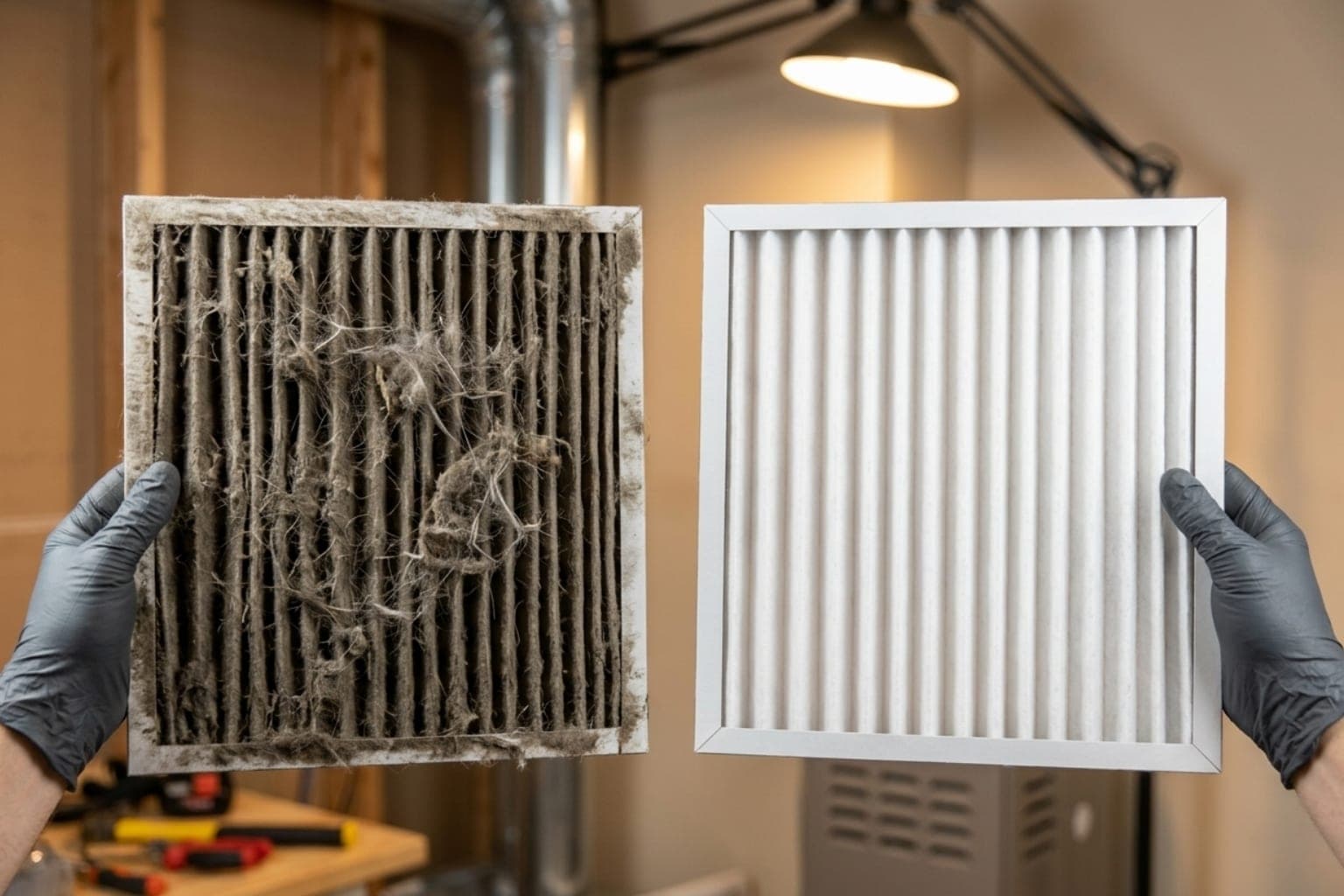
The easier rule of thumb is just looking at the filter: if it's gone from white to gray-brown, it's loaded and ready for replacement. If it's dark brown or black, it's overdue, and your furnace has been working harder than it should be.
Which Filter Rating Is Right for Utah Homes
Filters are rated by MERV (Minimum Efficiency Reporting Value), basically a measure of how fine the filter is. Higher numbers catch more pollution but also restrict airflow more, making your furnace work harder. Salt Lake City's sustainability program actually gives out free MERV 11 filters to residents during red-day air quality events; MERV 11 catches about 90 percent of typical pollution without overworking most furnaces.
MERV 13 catches even more (up to 95 percent of very fine particles, including some viruses), but it restricts airflow noticeably more. In older Utah homes with undersized return ductwork, dropping in a MERV 13 filter without first upgrading the ducts can choke the blower. That's covered in more detail on our furnace installation page. The technician confirms your ductwork can handle a higher-density filter before recommending one.
Maintaining Furnaces in Older Utah Homes (Pre-1990)
A lot of Wasatch Front homes (the Avenues, Federal Heights, Sugar House, Holladay, older Bountiful and Ogden neighborhoods) still have furnaces from the 1980s or earlier. These older systems aren't bad, but they wear in different patterns than newer high-efficiency furnaces. Annual maintenance on them needs to look at three specific things: the aging gas valve, the older-style heat exchanger, and the ductwork that was sized for the original furnace decades ago.
Checking the Gas Valve on Older Furnaces
Older furnaces use a single-stage gas valve (a part that opens and closes to let gas to the burners). The internal regulator spring weakens with age, allowing the gas pressure feeding the burners to drift higher than spec. Replacement parts for some older valves are also harder to find. Specialty HVAC distributors stock them, but they take a day or two to source.
The technician checks gas pressure with a small gauge during the tune-up. If the drift is mild (up to 5 percent over nominal), they can adjust it during the visit. If the drift is over 10 percent or won't hold after adjustment, the valve is at end-of-life and needs replacement. Replacing it during the scheduled tune-up runs $250 to $500 installed and avoids the emergency call later when the valve fails on a cold January night.
Inspecting Older-Style Heat Exchangers
Heat exchangers built before 1990 used a different metal (aluminized steel) than what most modern furnaces use today (stainless steel, on high-efficiency units). The older metal has thinner walls and less corrosion resistance, so it needs closer year-over-year tracking. Inspection frequency depends on what the technician sees:
- Heat exchanger looks clean: standard annual inspection is fine
- Some surface oxidation appearing: move to twice-a-year inspections
- Cracks, pitting, or corrosion all the way through the wall: the heat exchanger is done. Replacement is the only safe option (more on detection methods on our gas furnace repair page)
On older furnaces, technicians take photos of the heat exchanger condition during each annual visit. That builds up a year-over-year visual record that helps you and the technician decide when replacement is the right call.
Older Ductwork Loses Capacity Over Time
Salt Lake homes built between 1960 and 1985 typically had return ducts (the ducts that pull air back to the furnace) sized for the older blower motors used at the time. Over decades, those ducts accumulate dust in the joist bays, develop small leaks where seams have settled, and sometimes have zone valves or dampers added by previous owners that weren't accounted for in the original sizing.
The technician measures airflow restriction (called static pressure) on both the return and supply sides during your annual visit. If the reading has crept up over time, that means the system is working harder than it should. The technician traces the cause to clean it (debris, sealable leaks) or recommends adding return capacity. Cleaning during the visit runs $100 to $250. Adding return ductwork runs $300 to $1,200.
What Drives Furnace Tune-Up Pricing in Utah
Tune-up pricing is set by each partner technician and depends on system type (single-stage 80% AFUE vs. condensing 90%+ AFUE), filter scope, and whether you bundle filter replacement or a humidifier service into the visit. High-efficiency condensing furnaces carry slightly higher visit pricing because of the secondary heat exchanger and condensate-system inspection that single-stage units don't need.
If the inspection turns up a needed repair or full replacement, the tune-up fee is applied toward that follow-on work, so you're not paying the maintenance fee on top of the repair invoice. Many partners also run fall specials in September and October that price below peak-season rates. The dispatcher confirms exact figures when you book.
Standard tune-up scope is consistent across visits; add-on services performed during the maintenance trip are quoted separately from the visit itself. Common add-ons include altitude recalibration, capacitor replacement (if a failing capacitor is caught early), humidifier pad replacement, premium filter upgrades, return path cleaning, and aging gas valve replacement. Each add-on is presented as its own line item before the technician proceeds. Call (801) 421-0175 and the dispatcher walks you through what your specific system likely needs.
When to Schedule Furnace Maintenance
The ideal time is September through early November, before the first hard freeze. This gives technicians time to order parts if anything needs repair and gives you time to schedule repairs at standard rates rather than emergency pricing.
If you missed the fall window, scheduling maintenance in January or February during a mild spell is still valuable. Any professional inspection is better than none, regardless of timing.
How It Works
Getting matched with a trusted furnace technician is simple. Here's how we connect you with the right pro.
Tell Us Your Issue
Call us or fill out the form with details about your furnace problem. Same-day dispatch available.
Get Matched with a Tech
We connect you with a licensed, background-checked technician in your area. Usually within minutes.
Problem Solved
Your technician arrives, diagnoses the issue, and gets your heating system running. Written estimate before any work begins.
Need a Furnace Technician? We'll Match You in Minutes.
Call now or fill out our form to get connected with a licensed, background-checked heating technician in your area. Same-day availability in most locations.
DOPL-Licensed · Same-Day Dispatch · After-Hours Available
Why Homeowners Trust Us
We vet every technician in our network so you don't have to. Here's what sets our partner techs apart.
Licensed & Insured
Every technician in our network is state-licensed, fully insured, and background-checked for your peace of mind.
Same-Day Service
Most service calls are scheduled within 2-4 hours. Emergency dispatch available evenings, weekends, and holidays.
DOPL-Licensed Network
Every technician we connect you with carries an active Utah Division of Professional Licensing (DOPL) HVAC contractor license and full liability insurance. License status is verifiable through the Utah DOPL public lookup.
Transparent Estimates
You receive a written estimate before any work begins. The diagnostic charge is stated up front and rolls into your repair invoice once you approve the work, so there is no separate billing for the visit. No hidden charges, no surprise add-ons after the technician arrives.
What Utah Homeowners Say
Real reviews from homeowners we've connected with trusted local technicians.
“Our furnace died on the coldest night of the year. I called Utah Furnace Repair and they had a licensed tech at our door within 2 hours. He diagnosed the problem, had the part on his truck, and we had heat before bedtime. Incredible service.”
Sarah M.
Salt Lake City, UT
“I was quoted $4,000 by another company for a furnace replacement. Utah Furnace Repair connected me with a tech who found the real issue: a $200 igniter replacement. Honest, skilled, and saved me thousands.”
Mike T.
Sandy, UT
“From the phone call to the finished repair, the whole experience was seamless. The technician was on time, explained everything clearly, and left the work area spotless. I’ll be using this service for all my HVAC needs.”
Jennifer R.
West Valley City, UT
“We needed a new furnace installed in our home in SunCrest. The tech they matched us with was knowledgeable about high-altitude installations and did an outstanding job. Highly recommend.”
David L.
Draper, UT
“Scheduled a fall tune-up through Utah Furnace Repair. The technician was thorough, found a cracked heat exchanger we didn’t know about, and probably saved us from a dangerous situation. So grateful for the quality of their network.”
Lisa K.
Murray, UT
“Fast, professional, and affordable. The tech arrived exactly when they said he would, fixed our furnace in under an hour, and the price was very fair. This is how home services should work.”
Robert H.
Bountiful, UT
Furnace Maintenance FAQs
Service Areas Across Utah
Our network of licensed technicians serves communities throughout the Salt Lake City metro and beyond.
Salt Lake City
Salt Lake County
200,000+ residents
Sandy
Salt Lake County
96,000+ residents
Draper
Salt Lake County
51,000+ residents
West Valley City
Salt Lake County
140,000+ residents
West Jordan
Salt Lake County
116,000+ residents
South Jordan
Salt Lake County
77,000+ residents
Murray
Salt Lake County
50,000+ residents
Midvale
Salt Lake County
35,000+ residents
Taylorsville
Salt Lake County
60,000+ residents
Bountiful
Davis County
44,000+ residents
Layton
Davis County
82,000+ residents
Ogden
Weber County
87,000+ residents
Herriman
Salt Lake County
55,000+ residents
Riverton
Salt Lake County
45,000+ residents
Other Heating Services
Our network of partner technicians covers all your heating needs.
Furnace Repair
We connect you with licensed, background-checked heating pros in your area. Same-day appointments available.
Learn More →Furnace Installation
Licensed installers across the Wasatch Front. Free in-home estimates with sizing for altitude and ductwork compatibility.
Learn More →Emergency Heating Repair
No heat? We dispatch a licensed technician to your home fast. Available nights, weekends, and holidays.
Learn More →Heater Repair
Gas, electric, or heat pump. Our partner techs handle all heater types. Same-day service across Salt Lake City metro.
Learn More →Heat Pump Repair
Our partner technicians are trained on all major heat pump brands. Diagnosis and repair in one visit.
Learn More →Furnace Replacement
Licensed installers across the Wasatch Front. Right-sized AFUE selection, current ThermWise rebate stacking, and same-day estimates.
Learn More →Gas Furnace Repair
Gas furnace issues require certified technicians. Our partners are licensed for gas line work and furnace diagnostics.
Learn More →Boiler Repair
Boilers require specialized knowledge. Our partner techs handle steam, hot water, and radiant systems.
Learn More →