Furnace Replacement: Free Estimates from Certified Utah Pros
Our network installs Carrier, Lennox, Trane, Rheem, and more. Financing options available.
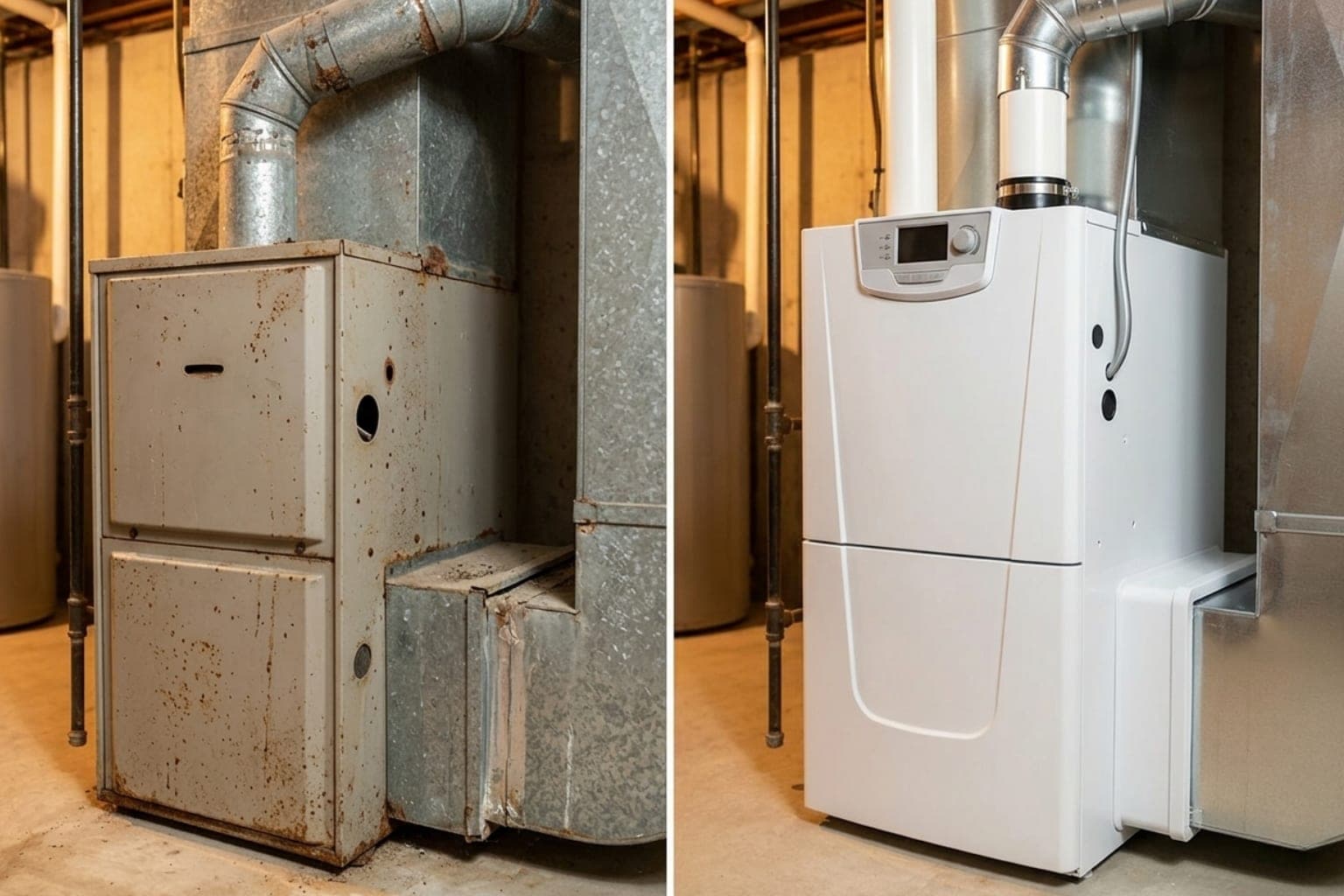
Is It Time to Replace Your Furnace? Five Things to Check
Every furnace eventually reaches a point where fixing it costs more than it's worth. The decision is rarely a single moment. It's usually a combination of age, repair history, climbing energy bills, comfort problems, and the size of the next likely repair. Below are the five signs that point toward replacement, plus the simple math that turns a gut feeling into an actual answer. (If you're still in repair-it territory, our furnace repair page covers that side.)
Age: Once You're Past 15 Years
Most gas furnaces in Utah homes last 15 to 20 years. Well-maintained units in mild climates can stretch to 25; neglected units in harsh winters fail at 12 to 14. Wasatch Front conditions tend to shorten the lifespan: hard water builds up on humidifier coils, inversion-season air loads filters faster, altitude-stressed combustion wears the heat exchanger, and the long cycles during deep-winter cold snaps tax every moving part. At 15+ years, most decisions tilt toward replacement. At 20+, the question isn't whether to replace. It's which one to buy.
Repairs Keep Happening More Often
One repair in a furnace's first ten years is normal. Two repairs in a single winter is a pattern. Three or more service calls in two winters means components are starting to fail in clusters: the control board, the blower, the gas valve all wearing out together. Each new fix extends the life of one part while the rest keep aging. Add up the staged repairs and they often cost more than just replacing the furnace, and the math only gets worse as the system gets older.
The 5,000 Rule and the 50% Rule
Two simple rules of thumb help you make the call. The 5,000 Rule: multiply the furnace's age by the repair quote. Over $5,000? Get a replacement quote alongside the repair estimate. A 16-year-old furnace with a $350 repair scores 5,600, close to the line. The 50% Rule: if the repair costs more than half of a brand-new replacement, replace it. A $3,000 heat exchanger fix on a furnace that costs $6,400 to replace fails the test even if it's only 12 years old. Both rules usually agree. When they don't, the older unit normally wins the tiebreaker for replacement, because the next repair after this one is rarely the last.
When a Cracked Heat Exchanger Forces the Decision
One diagnosis trumps the rules above: a cracked heat exchanger. (The heat exchanger is the metal chamber where your burners heat the air your furnace blows through the house.) The repair runs $1,500 to $3,500 in labor and parts, the replacement part rarely outlasts the rest of the older furnace it gets swapped into, and a cracked exchanger can leak carbon monoxide into your home. Most Utah technicians won't replace a heat exchanger on a furnace 15 years or older. The safety risk is real. Utah code requires working CO detectors in any home with a gas appliance, and a CO leak from a bad heat exchanger is exactly what those detectors are watching for.
Higher Bills, Cold Rooms, and Comfort Going Downhill
A furnace that worked fine last winter and now leaves rooms cold, or struggles to reach the temperature you set, is telling you something is wearing out inside. The usual suspects: a blower motor running below the speed it was designed for, a gas valve starting to misfire, or a heat exchanger losing efficiency before it cracks. These problems usually show up 6 to 18 months before the big repair lands. If your heating bill jumped 20 percent this winter and your gas rate didn't change, your furnace is burning more fuel to deliver less heat. Worth getting a replacement quote even if the unit still technically runs.
Buying the Right-Sized Furnace for Utah's Altitude
The biggest mistake in Utah furnace replacement is buying a furnace that's the wrong size for your home and elevation. Most furnaces show a heating output rating in BTUs (British Thermal Units, basically the unit of heat the furnace can produce) on the cabinet. But that number was measured at sea level. At Wasatch Front altitude, every furnace produces less heat than its label says. Building codes require installers to adjust the furnace down by about 4 percent for every 1,000 feet above 2,000 feet of elevation. That's called a high-altitude derate. Skip the derate and your furnace fires too hot, builds up soot, raises carbon monoxide output, and damages the heat exchanger ahead of schedule.
Why the BTU Rating on the Furnace Isn't What You Actually Get
At elevation, the air is thinner (less oxygen per cubic foot), so a gas burner designed for sea level burns “rich” in Salt Lake (too much fuel for the available air). Rich combustion produces less heat and more carbon monoxide. The 4-percent-per-1,000-feet rule is published by every major furnace manufacturer (Goodman, Trane, Rheem, Carrier, Lennox) in the installation manual that comes with the unit. A few specific Rheem condensing models use a slightly milder 2-percent rule because they're sealed-combustion designs. The math matters because an oversized, un-derated furnace short-cycles by switching on and off rapidly, never reaches its rated efficiency, and wears out faster than a properly sized furnace would.
What That Looks Like in Real Utah Cities
Here's what a furnace labeled “80,000 BTU” actually produces across the Wasatch Front, after the altitude derate is applied:
| City | Elevation (ft) | Derated 80k BTU input |
|---|---|---|
| Bountiful | 4,400 | 72,300 BTU (9.6% derate) |
| Salt Lake City | 4,226 | 72,900 BTU (8.9% derate) |
| West Jordan | 4,373 | 72,400 BTU (9.5% derate) |
| Sandy | 4,450 | 72,200 BTU (9.8% derate) |
| Draper | 4,505 | 72,000 BTU (10.0% derate) |
| Lehi | 4,570 | 71,700 BTU (10.3% derate) |
| Layton | 4,356 | 72,500 BTU (9.4% derate) |
| Ogden | 4,300 | 72,700 BTU (9.2% derate) |
| Heber | 5,604 | 68,500 BTU (14.4% derate) |
| Park City | 6,900 | 64,300 BTU (19.6% derate) |
Park City and Heber installs need an extra parts kit from the manufacturer (small brass nozzles called orifices that meter how much gas reaches each burner) on top of the derate calculation. Salt Lake Valley installs typically don't need the kit, but they do need a gas pressure adjustment when the unit is first started up. A furnace installed without that adjustment runs hotter than the manufacturer intended on every single cycle.
Why a Bigger Furnace Isn't a Better Furnace
Most homeowners assume a bigger furnace means a warmer house. At altitude, that's often backwards. A furnace that's too big short-cycles. The burner kicks on, hits your thermostat's target quickly, and shuts off before the system reaches its proper running temperature. Over a winter that wears out the igniter and gas valve, drops efficiency, and undermines your air filtration because the blower never runs long enough to fully clean the air during inversion season. The right-sized furnace is more comfortable, more efficient, lasts longer, and actually filters your air better. Bigger is not better.
Will Your Existing Ductwork Handle a New Furnace?
Your new furnace will only perform as well as your ductwork lets it. Modern high-efficiency furnaces use a type of blower motor called an ECM (a quieter, more efficient electric motor that varies its speed). These blowers expect ductwork that doesn't restrict airflow much. Unfortunately, a lot of 1980s and 1990s Salt Lake homes have undersized return ducts that were designed for older, simpler blower motors. Drop a high-end variable-speed furnace into that ductwork and the new motor has to work too hard, never hits its rated efficiency, and wears out faster. A good installer measures airflow restriction (called static pressure) during the estimate visit so you know whether duct upgrades are needed before you commit to the equipment.
Furnace Efficiency Levels (AFUE): What Each Tier Actually Saves
AFUE stands for Annual Fuel Utilization Efficiency, basically the percent of the gas you pay for that becomes heat in your home. An 80% AFUE furnace turns 80 cents of every dollar in gas into heat; the other 20 cents goes up the flue as exhaust. A 95% AFUE furnace recovers more of that exhaust heat before venting it out. The efficiency jump is real. The price jump is also real. The right level depends on what you pay for gas, how cold your house gets, and how long you plan to live there.
80% Efficiency: When the Cheaper Option Still Makes Sense
80% efficiency furnaces are still installable in Utah for replacement projects as of early 2026. They cost $1,500 to $2,500 less than a 95% efficiency furnace. The trade-off is higher gas bills for as long as you own the system. An 80% unit can make sense if you're selling within three years, if it's a part-time or vacation home, or if your existing chimney would be expensive to convert for a high-efficiency unit. For homeowners who plan to stay 7+ years, the 95% tier almost always pays back. The Department of Energy has an open rulemaking that may eventually require 90%+ efficiency on all new installs, but the rule has been delayed in court, so check the current status before committing to 80%.
90% to 92% Efficiency: The Middle Ground (With a Catch)
The entry-level high-efficiency tier. These furnaces capture some of the heat that would normally vent out, cutting gas use about 12 to 15 percent compared to 80%. The price gap from 80% to 90% is smaller than the gap from 90% to 95%, which is why some homeowners pick this tier as a compromise. The catch: 90% to 92% furnaces don't qualify for the Enbridge Gas ThermWise rebate ($300 to $350), which only kicks in at 95%. Once you factor that rebate in, going up to 95% usually beats settling at 90%.
95% Efficiency: The Sweet Spot for Most Utah Homes
95% efficiency is the best deal for most Utah single-family homes. It qualifies for the $300 to $350 ThermWise rebate from Enbridge Gas, install cost runs about $6,400 to $8,200 for a typical 80,000 BTU unit, and gas use drops about 18 to 20 percent compared to an 80% unit. For a Utah home spending $1,200 a year on heating, that's $215 to $240 in annual savings, meaning the upgrade pays for itself in roughly 6 to 9 years (or sooner if gas prices rise).
96% to 98% Efficiency: The Premium Tier
The top tier varies its output across multiple levels (called modulating) and pairs that with a continuous-low-speed blower. You get more even temperatures, quieter running, and noticeably better air filtration because the blower runs many more hours total. For Utah homes dealing with inversion-season air pollution, that continuous filtration matters. It's a real indoor air quality upgrade. Install cost runs $9,200 to $12,000 for an 80,000 BTU unit. The gas savings over 95% are small (only 3 to 5 percent more efficient). The value is in comfort, quiet, and filtration, not pure fuel savings. Best fit for permanent residences where allergies, asthma, or noise matter, or for homes already getting ductwork upgrades.
Single-Stage, Two-Stage, or Modulating: How Many Levels Should Your Furnace Have?
“Stages” refers to how many output levels the furnace can run at. Single-stage is on at full power, or off. Two-stage adds a lower power mode for mild weather. Modulating can vary output continuously across a wide range. The blower (the fan that pushes heated air through your ducts) also has different types: older fixed-speed motors, or quieter, more efficient variable-speed ECM motors. The combination of stages and blower type sets how comfortable and efficient your system feels.
Single-Stage: Acceptable, But Not Ideal for Utah Winters
Single-stage furnaces are sized for your home's coldest expected day (around 5°F for Salt Lake). On a milder 35°F October afternoon, they reach your set temperature in 4 to 6 minutes and shut off, then turn back on 10 to 15 minutes later. Every cycle wastes a little energy in startup and shutdown. For most of October and March, when your furnace is doing light work, single-stage delivers fewer comfortable hours per dollar of gas than a two-stage or modulating unit. Fine if you're on a tight budget; not optimal for a Utah winter that runs 100+ heating days.
Two-Stage vs. Modulating: Which Is Worth the Upgrade?
Two-stage adds a low-fire mode at about 65 to 70 percent of full output. On mild days the furnace runs longer at lower output, evening out room temperatures and running the blower more hours for filtration. Upgrading from single-stage to two-stage at 95% efficiency adds about $800 to $1,500. For most Utah homes, two-stage 95% efficiency is the comfort sweet spot. Modulating adds another $1,500 to $2,500 on top of two-stage, with smaller incremental comfort gains than the jump from single to two-stage. Modulating is best for homes with multiple zones, big temperature swings between floors, or anyone who'll appreciate near-silent operation.
Why the Variable-Speed Blower Matters for Air Quality
The blower upgrade isn't technically tied to the stage decision, but most 95%+ efficiency systems include a variable-speed ECM blower (ECM stands for Electronically Commutated Motor, a quieter, more efficient motor design). At low speed during continuous-fan mode, an ECM blower draws only $4 to $8 a month in electricity, versus $30 to $60 for an old-style fixed-speed motor. That difference is what makes 24/7 air filtration affordable. Pair the variable-speed blower with a thicker filter cabinet (4 or 5 inches deep) and a MERV 13 filter, and you'll see a real improvement in indoor air during inversion season, something a 1-inch filter slot just can't deliver.
What Furnace Replacement Actually Costs on the Wasatch Front
The cost of a furnace replacement depends on three variables: the size in BTUs (driven by your home's square footage and altitude-derated heating load), the AFUE efficiency tier, and the stage and blower configuration. The table below shows installed price ranges across the Wasatch Front for the most common pairings. All ranges include standard installation: equipment, basic labor, disposal of the old unit, and final commissioning.
Cost Table by AFUE Tier and BTU Size
| AFUE Tier | 60k BTU (≤1,800 sq ft) | 80k BTU (1,800–2,800 sq ft) | 100k BTU (2,800–4,000 sq ft) |
|---|---|---|---|
| 80% non-condensing single-stage | $4,200 to $5,500 | $4,800 to $6,200 | $5,400 to $7,000 |
| 92% AFUE single-stage | $5,200 to $6,800 | $5,800 to $7,500 | $6,400 to $8,400 |
| 95% AFUE single-stage (qualifies for ThermWise rebate) | $5,800 to $7,400 | $6,400 to $8,200 | $7,000 to $9,000 |
| 96-97% AFUE two-stage | $6,800 to $8,800 | $7,400 to $9,500 | $8,200 to $10,500 |
| 98% AFUE modulating + ECM variable-speed | $8,500 to $11,000 | $9,200 to $12,000 | $10,000 to $13,500 |
Bench neighborhoods (East Bench, Avenues, Federal Heights, Park City) often run 10 to 20% above the listed range due to access difficulty, older equipment removal complications, and longer drive times. Park City and Heber installs add a high-altitude orifice kit cost of $150 to $400 depending on manufacturer, plus extended commissioning time for elevation calibration. For installation-process detail (the work that's covered in these ranges), see our furnace installation page.
What's in the Bid (and What Isn't)
Standard installation included in the ranges above:
- Equipment cost (furnace, vent connections, condensate drain on condensing units)
- Removal and disposal of the old unit
- Basic labor for like-for-like replacement
- Manual J load calculation with altitude derate applied
- Mechanical permit (where required)
- Final commissioning including combustion analysis
Common add-ons not included in standard ranges:
- Ductwork modifications: $500 to $2,000 depending on scope
- Gas line resizing or rerouting: $400 to $1,200
- Vent abandonment or chimney chase modification (when going from Type B to Cat IV PVC): $400 to $1,200
- Electrical upgrade for ECM blower circuits: $200 to $600
- High-altitude orifice kit (Park City, Heber elevation): $150 to $400
- Smart thermostat (if not transferring existing): $150 to $400 installed
Old Equipment Removal Logistics
Replacing a furnace involves disposing of the old unit, which sounds simple until you account for what's attached to it. If your existing system has integrated air conditioning, the AC's indoor coil sits in the supply plenum directly above the furnace and must be either reused or replaced. Refrigerant recovery from the AC side is required by EPA Section 608 and adds $150 to $300 to a coil-replacement scope. Pre-1990 installations occasionally have asbestos transition tape at the duct connections, which requires abatement before the new unit goes in. Most replacements encounter neither issue, but both can surface during the estimate visit. Honest estimators flag them up front rather than discovering them mid-install.
2026 Utility Rebates That Lower the Cost
Two Utah utility rebate programs cut the upfront cost of a high-efficiency furnace. Enbridge Gas ThermWise pays $300 to $350 for any 95% AFUE or higher gas furnace, with the top of that range requiring a more efficient ECM blower at 97.5% AFUE. Rocky Mountain Power Wattsmart adds rebates when you pair the new furnace with a heat pump in a dual-fuel setup, which can range $700 to $1,200 depending on equipment efficiency. Both programs require the installer to be on the utility's approved contractor list, so DIY installs don't qualify. The federal Energy Efficient Home Improvement Credit (§25C) expired December 31, 2025 and is no longer available. Rebate amounts revise annually, so confirm current numbers at thermwise.com and wattsmarthomes.com before booking the install.
Should You Consider a Heat Pump Instead?
If you also need a new air conditioner, or if you've been thinking about moving away from gas heat, a cold-climate heat pump or dual-fuel system (heat pump plus gas furnace as backup) is worth comparing against a straight furnace replacement. Heat pumps qualify for Rocky Mountain Power Wattsmart rebates that gas furnaces don't, and they replace your AC at the same time. Whether the math works out depends on your electric and gas rates, how well your home is insulated, and whether your existing AC was due for replacement anyway. Our heat pump pagecovers when heat pumps make sense in Utah's climate, including the switchover-temperature math and the full rebate breakdown.
Decided to move forward with replacement?
For the install process itself, see our furnace installation page. It covers the pre-install walkthrough, ductwork retrofit considerations for older Utah homes, mechanical permit fees by city (Salt Lake City, Herriman, North Salt Lake, and others), the PVC vs. metal venting decision when upgrading from 80% to 90%+ efficiency, install day timeline, and converting from a boiler, electric, or oil system to gas.
How It Works
Getting matched with a trusted furnace technician is simple. Here's how we connect you with the right pro.
Tell Us Your Issue
Call us or fill out the form with details about your furnace problem. Same-day dispatch available.
Get Matched with a Tech
We connect you with a licensed, background-checked technician in your area. Usually within minutes.
Problem Solved
Your technician arrives, diagnoses the issue, and gets your heating system running. Written estimate before any work begins.
Need a Furnace Technician? We'll Match You in Minutes.
Call now or fill out our form to get connected with a licensed, background-checked heating technician in your area. Same-day availability in most locations.
DOPL-Licensed · Same-Day Dispatch · After-Hours Available
Why Homeowners Trust Us
We vet every technician in our network so you don't have to. Here's what sets our partner techs apart.
Licensed & Insured
Every technician in our network is state-licensed, fully insured, and background-checked for your peace of mind.
Same-Day Service
Most service calls are scheduled within 2-4 hours. Emergency dispatch available evenings, weekends, and holidays.
DOPL-Licensed Network
Every technician we connect you with carries an active Utah Division of Professional Licensing (DOPL) HVAC contractor license and full liability insurance. License status is verifiable through the Utah DOPL public lookup.
Transparent Estimates
You receive a written estimate before any work begins. The diagnostic charge is stated up front and rolls into your repair invoice once you approve the work, so there is no separate billing for the visit. No hidden charges, no surprise add-ons after the technician arrives.
What Utah Homeowners Say
Real reviews from homeowners we've connected with trusted local technicians.
“Our furnace died on the coldest night of the year. I called Utah Furnace Repair and they had a licensed tech at our door within 2 hours. He diagnosed the problem, had the part on his truck, and we had heat before bedtime. Incredible service.”
Sarah M.
Salt Lake City, UT
“I was quoted $4,000 by another company for a furnace replacement. Utah Furnace Repair connected me with a tech who found the real issue: a $200 igniter replacement. Honest, skilled, and saved me thousands.”
Mike T.
Sandy, UT
“From the phone call to the finished repair, the whole experience was seamless. The technician was on time, explained everything clearly, and left the work area spotless. I’ll be using this service for all my HVAC needs.”
Jennifer R.
West Valley City, UT
“We needed a new furnace installed in our home in SunCrest. The tech they matched us with was knowledgeable about high-altitude installations and did an outstanding job. Highly recommend.”
David L.
Draper, UT
“Scheduled a fall tune-up through Utah Furnace Repair. The technician was thorough, found a cracked heat exchanger we didn’t know about, and probably saved us from a dangerous situation. So grateful for the quality of their network.”
Lisa K.
Murray, UT
“Fast, professional, and affordable. The tech arrived exactly when they said he would, fixed our furnace in under an hour, and the price was very fair. This is how home services should work.”
Robert H.
Bountiful, UT
Furnace Replacement FAQs
Service Areas Across Utah
Our network of licensed technicians serves communities throughout the Salt Lake City metro and beyond.
Salt Lake City
Salt Lake County
200,000+ residents
Sandy
Salt Lake County
96,000+ residents
Draper
Salt Lake County
51,000+ residents
West Valley City
Salt Lake County
140,000+ residents
West Jordan
Salt Lake County
116,000+ residents
South Jordan
Salt Lake County
77,000+ residents
Murray
Salt Lake County
50,000+ residents
Midvale
Salt Lake County
35,000+ residents
Taylorsville
Salt Lake County
60,000+ residents
Bountiful
Davis County
44,000+ residents
Layton
Davis County
82,000+ residents
Ogden
Weber County
87,000+ residents
Herriman
Salt Lake County
55,000+ residents
Riverton
Salt Lake County
45,000+ residents
Other Heating Services
Our network of partner technicians covers all your heating needs.
Furnace Repair
We connect you with licensed, background-checked heating pros in your area. Same-day appointments available.
Learn More →Furnace Installation
Licensed installers across the Wasatch Front. Free in-home estimates with sizing for altitude and ductwork compatibility.
Learn More →Furnace Maintenance
Keep your heating system running efficiently. Our partner techs perform 21-point inspections.
Learn More →Emergency Heating Repair
No heat? We dispatch a licensed technician to your home fast. Available nights, weekends, and holidays.
Learn More →Heater Repair
Gas, electric, or heat pump. Our partner techs handle all heater types. Same-day service across Salt Lake City metro.
Learn More →Heat Pump Repair
Our partner technicians are trained on all major heat pump brands. Diagnosis and repair in one visit.
Learn More →Gas Furnace Repair
Gas furnace issues require certified technicians. Our partners are licensed for gas line work and furnace diagnostics.
Learn More →Boiler Repair
Boilers require specialized knowledge. Our partner techs handle steam, hot water, and radiant systems.
Learn More →