Furnace Maintenance in Salt Lake City, Utah
SLC's water comes from a 6-source portfolio drawn from 130 square miles of protected watershed in City Creek, Parleys, Big Cottonwood, and Little Cottonwood canyons.
Hardness runs 16 to 25 GPG downtown, moderately above the canonical 13+ GPG Salt Lake County baseline. Federal Heights and The Avenues run 15 to 20 GPG with trace ferrous iron from older water-main laterals.
Why Maintenance Matters in Salt Lake City
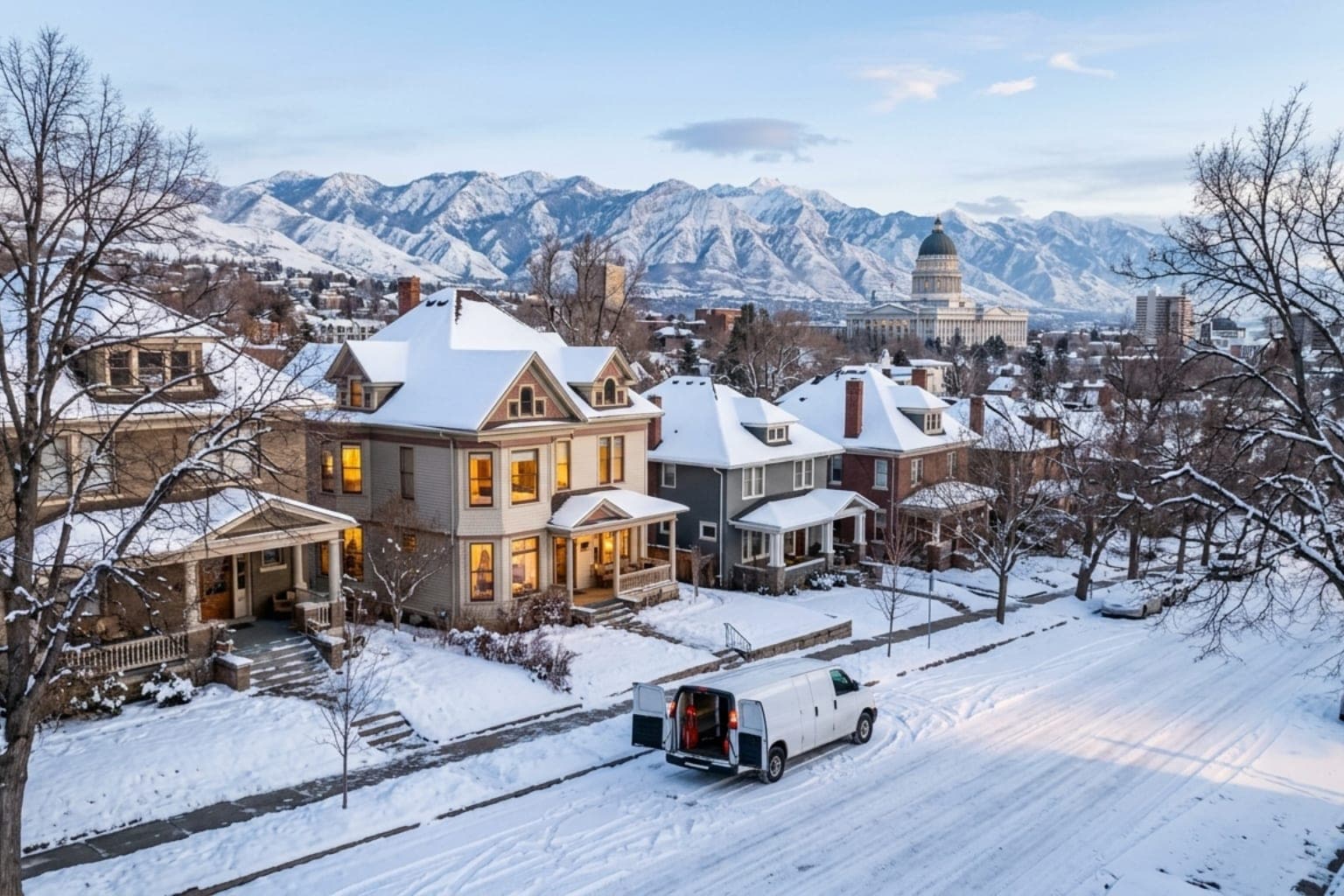
SLC has the most diverse tune-up scope in our coverage area. Pre-1940 boiler/hydronic systems in The Avenues and Marmalade. Mid-century 80% AFUE on the west side. Modern condensing on newer infill. Downtown VRF and ductless mini-splits. We tune for what you actually have, not a generic checklist.
What a 21-Point Tune-Up Includes
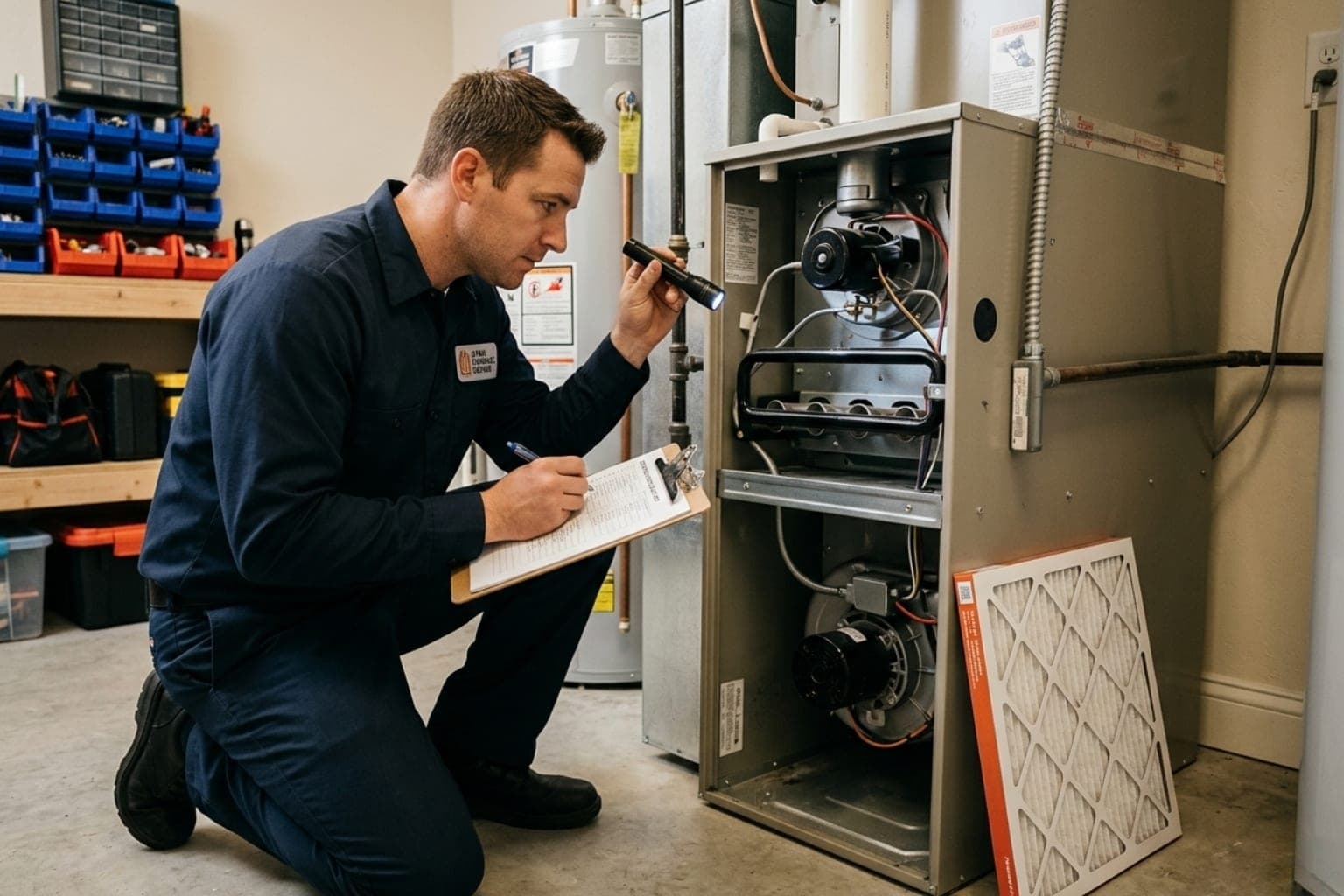
Safety checks: CO testing, gas leak detection, heat exchanger inspection, venting verification
Combustion analysis: Gas pressure verification, altitude calibration, flame inspection
Mechanical inspection: Blower motor, bearings, belt, inducer motor, thermostat calibration
Cleaning: Burner assembly, flame sensor, air filter, blower wheel, condensate drain
Electrical testing: Safety controls, limit switches, capacitor, wiring connections
Housing Stock and Heating Patterns in Salt Lake City
Tune-up scope depends on which SLC era your home is from.
In pre-1940 housing (The Avenues, Marmalade, Capitol Hill, parts of Federal Heights), the equipment is often a boiler or hydronic system. We check pressure-switch operation, low-water-cutoff verification, expansion tank inspection, circulator pump evaluation, and cast-iron radiator bleeding. Steam systems get separate scope. On homes converted to forced-air, we check for gravity-furnace conversion artifacts and knob-and-tube electrical remnants.
In early-1900s Sugar House, 9th and 9th, Federal Heights, and Liberty Wells craftsman/bungalow stock, the scope mixes hydronic and forced-air work. Heat exchanger inspection on third or fourth-generation 80% AFUE replacement is part of the standard scope on converted homes. Original ductwork sized for the converted gravity-flow chase often fails static-pressure tests with modern high-MERV filters.
In post-WWII west-side housing (Glendale, Poplar Grove, Rose Park), the equipment is mostly third-cycle 80% AFUE. We focus on visual borescope check of the heat exchanger year over year for cracks. We also check capacitor wear, blower motor condition, gas valve manifold pressure verification, and the original galvanized B-vent flue at the chimney chase.
In modern downtown high-rises and condos, the scope shifts to ductless mini-split refrigerant-line inspection, condensate-line check on shared common-stack handling, and smart-thermostat configuration verification.
Either way, we replace the filter and size the next change interval based on inversion-season particulate loading. Valley-floor SLC at 4,226 feet follows the canonical 30-to-45-day cadence at MERV 11 during inversion season. East-bench Avenues, Capitol Hill, and Federal Heights above 4,800 feet often sit above the inversion layer on multi-day winter inversion episodes. The cadence stretches to 60 to 90 days at MERV 11 there. That's a parallel pattern to Sandy SunCrest and Bountiful east-bench.
Maintenance Patterns for Salt Lake City Homes
Three recurring maintenance items in SLC have specific local notes worth knowing.
First, water hardness and the SLCDPU portfolio. Salt Lake City Department of Public Utilities runs the queue's most complex municipal utility. Combined water, sewer, stormwater, and street lighting. The 6-source portfolio runs City Creek, Parleys Creek, Big Cottonwood Creek, Little Cottonwood Creek, local groundwater, and Deer Creek / MWDSLS wholesale. MWDSLS is the Metropolitan Water District of Salt Lake & Sandy. The 130 square miles of protected watershed in the canyons run under SLC Ordinances 17.04 and 17.08 (Watershed Protection) and 21A.34.060 (groundwater zoning).
Hardness runs 16 to 25 GPG downtown, with summer-2015 spikes documented to 22 to 25 GPG. Federal Heights to The Avenues runs 15 to 20 GPG with sediment and trace ferrous iron from older water-main laterals. SLC water is hard but considerably softer than Riverton (33 GPG) and the worst Herriman summer wells. Comparable to Ogden and Layton in the moderately-hard range. SLC water is NOT soft, despite some sources misrepresenting it that way.
Fluoride status: naturally-occurring only, no longer added under Utah HB81 effective May 7, 2025. SLCDPU's fluoride pumps at all four treatment plants (City Creek, Parleys, Big Cottonwood, Little Cottonwood) were turned off that date. Naturally-occurring fluoride remains and is monitored.
Second, sewer and stormwater. SLCDPU also handles sewer/wastewater for about 200,000 SLC customers via the SLC Water Reclamation Facility (the city's only wastewater treatment plant). A new facility is under construction.
Third, air quality. SLC is the canonical reference point for the Salt Lake Valley nonattainment area. The entire SIP modeling and inventory framework is anchored on SLC monitoring data. East-bench Avenues, Capitol Hill, and Federal Heights often sit ABOVE the inversion layer during multi-day winter episodes, which gives those homes a useful filter-cadence override.
If you're replacing a natural-gas water heater alongside the furnace, HB 313 (2025) added NOx limits effective July 1, 2025. The limits still apply because we're in PM2.5 nonattainment.
Related Service Depth for Salt Lake City
A few things on this page show up in broader form on our service pages.
Our furnace maintenance page covers the canonical Salt Lake County hard-water content (13+ grains per gallon average) and the inversion-season filter loading framework. SLC's 16 to 25 GPG downtown is moderately above canonical, with east-bench 15 to 20 GPG plus trace ferrous iron noted. SLC is also the dual-zone reference: valley-floor canonical inversion exposure, plus east-bench above-inversion override (60 to 90 day cadence). Parallel to Sandy SunCrest and Bountiful east-bench.
Our gas furnace repair page covers altitude calibration depth. SLC's 4,226 ft is the canonical reference for that entire framework. East-bench addresses 4,800 to 5,000+ feet need additional tuning beyond the baseline.
If you have a boiler or hydronic system, our boiler repair page goes deeper. SLC is one of two cities in our coverage area (alongside Ogden) where the boiler cross-link is genuinely supported by housing stock.
Local Context for Salt Lake City Homeowners
Two scheduling notes specific to SLC.
The standard fall-service window (September through October) applies. Pre-1940 historic-district homes book up faster because the diagnostic scope is longer. Boiler scope, gravity-conversion artifact inspection, and knob-and-tube routing in attic chases all add time. Plan accordingly if you're in The Avenues, Marmalade, Capitol Hill, Federal Heights, Sugar House, or 9th and 9th.
Downtown condos and high-rises often run on building-managed maintenance contracts. We coordinate with HOA and property-management dispatchers for in-unit equipment when the building handles common-stack and exterior work separately.
If cost is a barrier, two programs can help. The federally-funded HEAT (Home Energy Assistance Target) program and the Utah Weatherization Assistance Program. Both run through Utah's Department of Workforce Services. Eligibility is income-based and open to non-citizens with qualifying status. Federal incentives also apply where eligible.
One note on SLC's growth profile: the 2024 estimate of 217,783 reflected the biggest population growth of any Utah city that year (+5,950 / +2.8 percent). Mayor Mendenhall's framing of 'not going to look the same in 10 years' captures the build-out pace. The Olympic-driven downtown infrastructure (Delta Center renovation, Inland Port, Green Loop, Main Street Promenade, TRAX expansion, airport Phase 2) anchors that trajectory.
Serving Salt Lake City Neighborhoods
Our partner technicians serve all Salt Lake City neighborhoods including Sugar House, The Avenues, Liberty Park, Marmalade, Downtown, Rose Park, Glendale.
Zip codes served: 84101, 84102, 84103, 84104, 84105, 84106, 84108, 84109, 84111, 84115, 84116
Need a Furnace Technician? We'll Match You in Minutes.
Call now or fill out our form to get connected with a licensed, background-checked heating technician in your area. Same-day availability in most locations.
DOPL-Licensed · Same-Day Dispatch · After-Hours Available
Why Homeowners Trust Us
We vet every technician in our network so you don't have to. Here's what sets our partner techs apart.
Licensed & Insured
Every technician in our network is state-licensed, fully insured, and background-checked for your peace of mind.
Same-Day Service
Most service calls are scheduled within 2-4 hours. Emergency dispatch available evenings, weekends, and holidays.
DOPL-Licensed Network
Every technician we connect you with carries an active Utah Division of Professional Licensing (DOPL) HVAC contractor license and full liability insurance. License status is verifiable through the Utah DOPL public lookup.
Transparent Estimates
You receive a written estimate before any work begins. The diagnostic charge is stated up front and rolls into your repair invoice once you approve the work, so there is no separate billing for the visit. No hidden charges, no surprise add-ons after the technician arrives.
What Utah Homeowners Say
Real reviews from homeowners we've connected with trusted local technicians.
“Our furnace died on the coldest night of the year. I called Utah Furnace Repair and they had a licensed tech at our door within 2 hours. He diagnosed the problem, had the part on his truck, and we had heat before bedtime. Incredible service.”
Sarah M.
Salt Lake City, UT
“I was quoted $4,000 by another company for a furnace replacement. Utah Furnace Repair connected me with a tech who found the real issue: a $200 igniter replacement. Honest, skilled, and saved me thousands.”
Mike T.
Sandy, UT
“From the phone call to the finished repair, the whole experience was seamless. The technician was on time, explained everything clearly, and left the work area spotless. I’ll be using this service for all my HVAC needs.”
Jennifer R.
West Valley City, UT
“We needed a new furnace installed in our home in SunCrest. The tech they matched us with was knowledgeable about high-altitude installations and did an outstanding job. Highly recommend.”
David L.
Draper, UT
“Scheduled a fall tune-up through Utah Furnace Repair. The technician was thorough, found a cracked heat exchanger we didn’t know about, and probably saved us from a dangerous situation. So grateful for the quality of their network.”
Lisa K.
Murray, UT
“Fast, professional, and affordable. The tech arrived exactly when they said he would, fixed our furnace in under an hour, and the price was very fair. This is how home services should work.”
Robert H.
Bountiful, UT
Frequently Asked Questions
Service Areas Across Utah
Our network of licensed technicians serves communities throughout the Salt Lake City metro and beyond.
Sandy
Salt Lake County
96,000+ residents
Draper
Salt Lake County
51,000+ residents
West Valley City
Salt Lake County
140,000+ residents
West Jordan
Salt Lake County
116,000+ residents
South Jordan
Salt Lake County
77,000+ residents
Murray
Salt Lake County
50,000+ residents
Midvale
Salt Lake County
35,000+ residents
Taylorsville
Salt Lake County
60,000+ residents
Bountiful
Davis County
44,000+ residents
Layton
Davis County
82,000+ residents
Ogden
Weber County
87,000+ residents
Herriman
Salt Lake County
55,000+ residents
Riverton
Salt Lake County
45,000+ residents